

That is an version of The Atlantic Day by day, a e-newsletter that guides you thru the largest tales of the day, helps you uncover new concepts, and recommends one of the best in tradition. Join it right here.
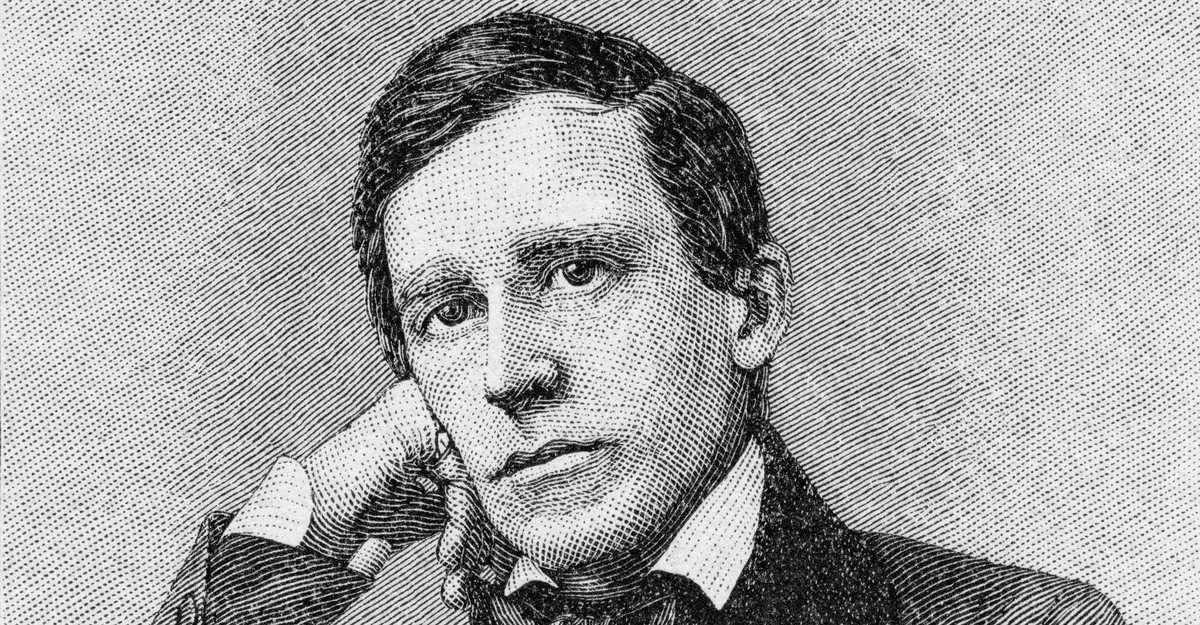
Two-hundred years in the past, on July 4, 1826, america celebrated its fiftieth birthday. Thomas Jefferson and John Adams died. And one other enduring voice was born: the songwriter Stephen Foster.
The timing is becoming, for Foster is a quintessentially American determine. His title will not be as well-known because it as soon as was—nor as well-known as successors reminiscent of Cole Porter or Irving Berlin—however his affect on music stays big. Songs like “Oh! Susanna,” “Camptown Races,” and “Outdated Of us at Residence” stay acquainted, even when many assume that they’re conventional folks songs. Foster successfully invented the thought of an expert songwriter; based the American songbook and pioneered the now-standard verse-chorus construction; and impressed the intellectual-property regulation of music. His premature loss of life set the template for the doomed, dissolute musician. In the meantime, the racist components of his music, and the racial dynamics of his period, proceed to complicate his legacy. What might be extra American than that?
Foster was born right into a outstanding household in Pittsburgh. He had neither the curiosity nor aptitude for enterprise or a lot else, however he managed to discover a area of interest writing songs, usually both for minstrel bands or to be bought as sheet music. “All he had was his means to create poetry and melody and put them collectively,” Deane L. Root, a professor emeritus of music on the College of Pittsburgh and a Foster scholar, instructed me. By doing that, he created the mannequin for the skilled songwriters who’ve adopted—Tin Pan Alley, the Brill Constructing, Motown’s Holland-Dozier-Holland crew, Nashville’s Music Row, and modern-day hitmakers reminiscent of Max Martin.
The guitarist Invoice Frisell has been recording Foster’s music because the early Nineties and even named a bunch “Lovely Dreamers” after the Foster composition, however he first encountered the songs as a younger little one. “It’s simply the right mannequin for what a melody and the type of a tune will be,” he instructed me. “There’s 1,000,000 different composers, however simply pondering of popular-song type, in a means this looks as if floor zero for a lot stuff that we now have now.” Frisell has recorded “Exhausting Occasions” as each a rollicking swing tune and a wistful lament, which he mentioned is a testomony to the tune’s craftsmanship. “The melody simply will get so deep down in you. It’s just like the trunk of a tree, or the roots of the tree, after which you can begin climbing round up there.”
Musical ability, then as now, was not sufficient to ensure monetary stability. Early in his profession, Foster had a significant hit with “Oh! Susanna” in 1847. However regardless of writing dozens of songs, he struggled to earn a constant dwelling, making $10 to $15 a tune—$400 to $500 right this moment. “He didn’t have an agent, he didn’t have a lawyer who may work this for him. He didn’t have any individual who knew the enterprise on his behalf, writing up contracts with publishers and theater homeowners and all the remaining,” Root mentioned. Foster died destitute in 1864, after falling and injuring himself within the toilet of a resort on the Bowery, changing into maybe the primary of many well-known wastrels in American standard music. In response to legend, Foster was drunk, although consultants dispute this.
Foster’s songs grew to become ubiquitous—folks generally mistook them for people songs even throughout his lifetime—and had been carried out all over the place from again porches to opera homes, in each style possible. However the man himself grew to become greatest identified solely after his loss of life, due to a fierce reputation-building effort by his brother. Within the Nineties, Root instructed me, Foster grew to become the primary American composer to have his work collected in a ebook. This raised his profile and made him a mannequin for a brand new era of songwriters, who copied his verse-chorus construction. When Berlin and others fashioned ASCAP, now the main performance-rights group, to deal with royalties in 1914, that they had Foster in thoughts as a cautionary story.
Talking about Foster with out speaking about race is not possible. Frisell instructed me he’d lain awake the night time earlier than we spoke, occupied with how tough it was to debate. The main standard music of the period was minstrelsy, which, because the musician Melvin Gibbs writes in his new ebook, How Black Music Took Over the World, “introduced the model of Blackness that white audiences had been prepared to just accept.” White minstrel musicians would both commercialize Black tradition (a sample that persists in standard music) or else carry out exaggerated stereotypes of it. Lots of Foster’s songs had been written for Christy’s Minstrels, a significant minstrel troupe of the 1840s and 1850s that carried out in blackface, and his lyrics site visitors in slurs, pro-Accomplice sentiments, and revisionism concerning the horrors of slavery, regardless that he’d witnessed it himself. (Foster’s private politics are powerful to pin down; he additionally wrote pro-Union songs, and he appears to have been most fascinated with getting a paycheck.)
“My Outdated Kentucky Residence” is that commonwealth’s state tune, and it’s a staple of the Kentucky Derby. The lyrics describe the sorrows of a household separated by slavery, and Frederick Douglass praised the tune for awakening abolitionist sentiments. But the phrases additionally embody a slur that was sanitized in 1986—jarringly late. Among the many Looney Tunes segments that function his music had been later withdrawn from circulation due to their offensive materials. However the nice Black bass-baritone and civil-rights activist Paul Robeson additionally recorded “My Outdated Kentucky Residence” in its unexpurgated type, forcing listeners to confront the unique content material and context.
The musician-scholar Rhiannon Giddens, a number one interpreter of Nineteenth-century American songs, instructed me that discussing Foster’s context is tough as a result of minstrel leisure is so little understood right this moment. “I don’t know if he was any extra racist than the common individual” of his time, she mentioned. “He was simply making an attempt to make a buck.” She finds Foster extra fascinating for what he represents than who he was as a person.
For a Could live performance at Carnegie Corridor, a part of commemorations of the nation’s 250th anniversary, she closed a set with “Exhausting Occasions.” Giddens doesn’t carry out Foster’s music a lot, seeking to highlight lesser-known work, however she determined it was the correct piece for the second. For me and for many others, it’s Foster’s most interesting work. The tune is untainted by dialect, with a memorable tune and highly effective lyrics, and I’ve discovered it a salve throughout current onerous occasions. Regardless of the flaws of Foster and his music, Giddens mentioned, “The person may write a tune.” When she and her backing group performed “Exhausting Occasions,” it introduced down the home, simply because it has carried out for some 170 years now.
Associated:
Listed here are three new tales from The Atlantic:
At the moment’s Information
- Russia hit Kyiv with nearly 500 drones in a large-scale assault final night time that killed a minimum of 21 folks and wounded 85 extra, based on town’s mayor.
- At the least 2,295 persons are confirmed to have died within the Venezuelan earthquakes, and almost 50,000 folks stay lacking.
- A U.S. Olympian was indicted for destruction of property after he was arrested for allegedly touching a bit of indifferent coating within the Reflecting Pool final month. The Olympian says he didn’t take away or destroy any of the coating.
Extra From The Atlantic
Tradition Break

Debate. A movie critic’s new ebook assaults the medium for diminishing tradition. Hardly ever has David Thomson been extra flawed, Michael O’Donnell argues.
Examine. The web couldn’t get sufficient of “Freddy,” a German vacationer on an epic World Cup highway journey, Will Oremus writes. Why did he immediately go silent?
Play our day by day crossword.
PS
Although Foster’s renown grew within the a long time after his loss of life, Atlantic readers (then as now) would have been higher knowledgeable. In 1867, three years after he died, the journal revealed a remembrance by Robert P. Nevin, who knew Foster from Pittsburgh. Nevin remembered the songwriter as a melancholic genius, and insisted that Foster didn’t merely caricature Black People however used their vernacular to convey common themes. “Could the time be far sooner or later ere lips fail to maneuver to its music, or hearts to answer its affect,” Nevin wrote. That point has not come but.
— David
Stephanie Bai contributed to this text.
Once you purchase a ebook utilizing a hyperlink on this e-newsletter, we obtain a fee. Thanks for supporting The Atlantic.
