

That is an version of Time-Journey Thursdays, a journey by way of The Atlantic’s archives to contextualize the current. Join right here.
In February 1896, when the germ idea of illness was nonetheless pretty new, an Atlantic author puzzled whether or not the “good old style hand-shake” would survive into the following century: “Will it a while be as out of date because the curtsy with which our grandmothers greeted the beaux of their day, or the kiss that the gallant impressed on the delicate hand that he raised so respectfully to his lips?”
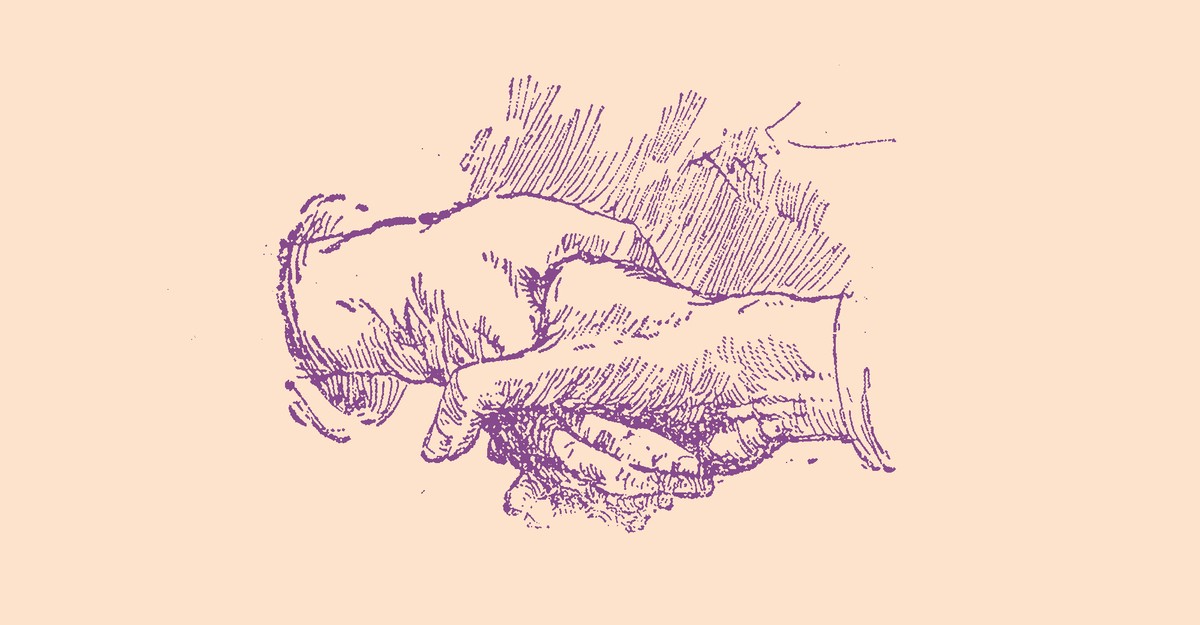
But all these years later, the handshake stays the default type of greeting in America. We proceed to succeed in out—thumbs up, fingers relaxed, palms turned to the aspect—each time we make somebody’s acquaintance or seal a deal. Even the coronavirus pandemic couldn’t kill the handshake, although it appeared for a second prefer it would possibly. In 2020, Anthony Fauci, then the director of the Nationwide Institute of Allergy and Infectious Illnesses, inspired People to discard the unhygienic observe for the sake of our collective well being (one other infectious-disease skilled went so far as deeming the handshake a “bioweapon”). And, for a time, some strangers did hold their distance. However ultimately the vaccines had been launched, the masks got here off, and the flesh continued to be pressed.
My very own aversion to the handshake is rooted much less in fear about viral transmission and extra within the tendency of sure fellow males—and, in my expertise, it’s invariably a male phenomenon—to make use of the gesture as a chance to claim dominance. Their handshakes aren’t merely agency; they’re vice-like. This character was dubbed the “knuckle-cruncher” in these pages by the author David Hammarstrom Jr. in 1977. Hammarstrom insisted that the key to defending in opposition to aggression masquerading as civility was to “get your hand into his as rapidly and snugly as you may, earlier than he had the prospect to show you right into a lefty.”
That tactic would possibly spare your digits, however you’re nonetheless left weak to the equally abhorrent arm-wrencher—i.e., the man who doesn’t shake your hand a lot as try to separate your shoulder from its socket. President Trump is the best-known practitioner of this system, and you may see it on show not too long ago when he welcomed King Charles III to the White Home (although, as others have famous, it appeared that the British monarch, conscious of the president’s proclivity, had braced himself for—apologies—the Yank’s yank). In 2020, The Atlantic’s Megan Garber argued that the handshake wasn’t as pleasant and egalitarian because it appeared, and {that a} grip deemed weak or clammy may undermine a primary impression. “Respect for the opposite” is “the idea of etiquette,” she wrote. “The handshake now not matches that ethos.”
However then there’s the issue of what does match that ethos. A hug is simply too intimate for strangers. A head nod is simply too distant for shut associates. It’s onerous to think about People agreeing en masse to begin bowing to at least one one other; likewise, the sunshine kiss on the cheek might be too alien to our nationwide sensibilities to ever totally catch on. Plenty of novel options have been proposed, together with touching footwear and tapping elbows, however most of them feel and look ridiculous. Essentially the most viable possibility is the fist bump. In 2013, James Hamblin made the case that the transfer satisfies our want for bodily contact (“I’m extending my arm to the touch you”) with out partaking in full-on, palm-to-palm intimacy.
As for what to do if the opposite particular person declines to satisfy your knuckles with theirs, Hamblin provides this suggestion: “In the event that they don’t acknowledge your fist and match it, you possibly can whisper ‘Consider the kids.’” (For the report, though the fist bump typically will get known as a “dap,” the latter is a much more expansive and playful class. As Ta-Nehisi Coates wrote in 2008, the dap originated within the Black group—possible through the Vietnam Warfare, in accordance with some accounts; right this moment you possibly can witness essentially the most impressively elaborate variants exchanged earlier than NBA video games.) Nonetheless, it’s affordable to fret whether or not the fist bump—of which I’m an advocate—is acceptable in additional severe settings. Do you actually wish to danger fist bumping the particular person interviewing you for a job?
The handshake is undeniably a mainstay of American etiquette, for higher and worse, and that most likely means that it’ll endure. These of us who aren’t followers can keep it up with our fist bumps, aspect hugs, or no matter else we provide you with, in hopes that society would possibly at some point choose a preferable substitute. However the old style customary could be unattainable to shake.
