


Most runners know they need to heat up earlier than a run, but they don’t really know why.
You’ve most likely grabbed your footwear, stepped outdoors, and began operating at purpose tempo inside two minutes.
It felt wonderful on the time, although a bit stiff within the first mile.
However right here’s what you didn’t see: your muscular tissues had been working at a major drawback.
Your muscle fibers had been chilly, stiff, and way more weak to ripping than they’d have been after a correct warm-up.
Your nervous system wasn’t totally activated but, so your stride coordination was barely off.
Your oxygen supply system was enjoying catch-up as a substitute of operating at capability.
And relying on the space and depth you deliberate to run, you might need left efficiency on the desk earlier than you even completed your warm-up.
Most runners perceive warm-up as one thing they “ought to do” with out understanding what really occurs of their physique after they do or don’t.
So, on this article you’re going to study the research-backed sensible recommendation on:
- What occurs if you skip a warm-up and why your muscular tissues develop into considerably extra weak to harm
- How your physique prepares itself for operating and which physiological modifications you possibly can speed up
- How you can match your warm-up to your run kind so that you get the appropriate preparation for straightforward runs, velocity work, and race day
What Occurs to Your Muscular tissues When You Skip a Heat-Up?
Your muscular tissues work like springs with temperature-dependent properties.
After they’re chilly, they’re stiffer and fewer elastic, which modifications how drive travels by way of your tissues.
Analysis has proven that the vitality required to trigger a muscle tear is considerably decrease when muscular tissues are beneath 32°C in comparison with core physique temperature at 37°C.
Analysis has proven that chilly muscular tissues require considerably much less vitality to maintain everlasting harm, with the best vulnerability occurring beneath 32°C.
Your peripheral muscular tissues (those in your legs, hips, and shoulders) typically sit on the low 30s and even mid-20s, particularly in cool situations.
This temperature hole between your core and your limbs is precisely why chilly muscular tissues tear extra simply.
The second consequence of skipping a warm-up is metabolic lag.
Your cardio techniques take a number of minutes to achieve capability, even in the event you really feel able to run.
With no warm-up, your early operating minutes are fueled much less effectively, which suggests your physique burns by way of vitality reserves sooner and accumulates fatigue extra shortly.
Your muscular tissues develop into considerably extra tear-prone at temperatures beneath 32°C, which is why even a quick warm-up issues earlier than onerous operating.
Why Does Your Physique Temperature Matter Extra Than You Assume?
Muscle temperature is the one most essential issue controlling how your muscular tissues carry out.
Once you elevate your muscle temperature by way of gentle jogging, you set off a cascade of physiological modifications that enhance almost each side of your operating.
The primary change is mechanical.
Hotter muscular tissues develop drive sooner, which suggests you possibly can generate energy extra shortly with every stride, and your muscular tissues can chill out sooner between contractions.
The second change is chemical.
Oxygen binds extra readily to hemoglobin at hotter temperatures, which means your blood releases oxygen extra effectively to working muscular tissues.
The metabolic enzymes that energy muscle contraction additionally work sooner in hotter tissue.
This mixture means your cardio engine fires up extra shortly if you begin operating onerous.
RunnersConnect Bonus
Obtain our Lively Stretching Upkeep Routine
It’s a PDF and video with pictures and descriptions of the simplest lively stretches for runners.
The third change includes your nervous system.
Nerve conduction velocity (how briskly alerts journey between your mind and your muscular tissues) will increase with temperature.
For this reason your first few strides after a correct warm-up really feel extra coordinated than these first few strides if you skip it fully.
Your muscular tissues reply sooner, your timing improves, and your motion sample feels extra environment friendly.
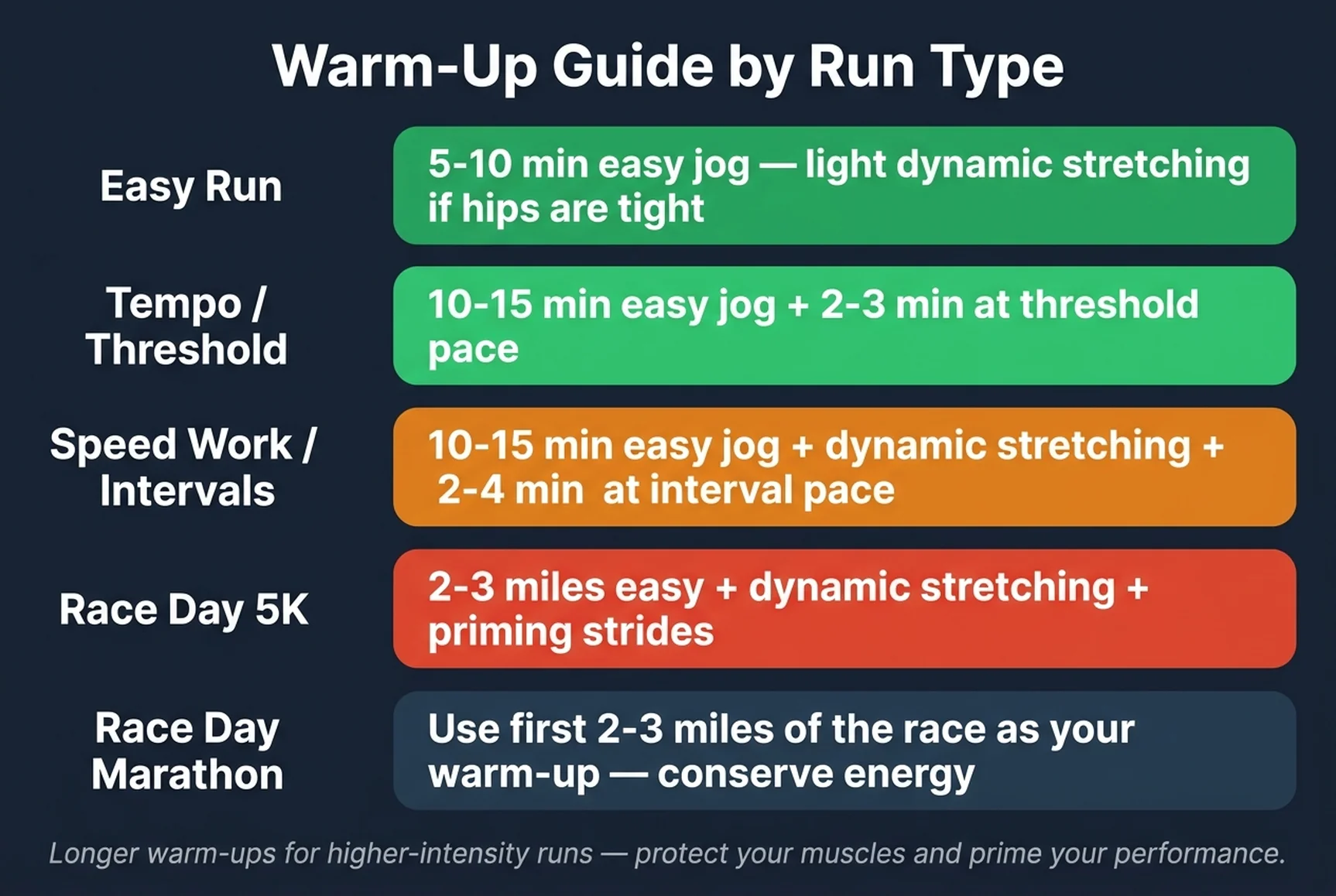
How Lengthy Ought to You Heat Up? It Is determined by Your Run Kind
The perfect warm-up length and depth rely fully on what you’re about to run.
A 20-minute warm-up earlier than a simple 30-minute run is wasteful and can go away you fatigued earlier than the principle effort.
A 5-minute warm-up earlier than a 5K race is inadequate and can go away efficiency on the desk.
The precept is straightforward: match your warm-up depth and length to your run depth.
What Ought to You Do Earlier than Straightforward Runs?
Straightforward runs kind the inspiration of each runner’s coaching, and so they require minimal warm-up.
5 to 10 minutes of straightforward jogging is adequate to boost your muscle temperature and put together your cardio system.
You’ll be able to embrace gentle dynamic stretching in case your hips are tight, however nothing extra is required.
Straightforward runs want simply 5 to 10 minutes of sunshine jogging to boost muscle temperature with out burning fatigue earlier than the principle effort.
What Ought to You Do Earlier than Tempo and Threshold Runs?
Threshold runs sit on the boundary between straightforward and onerous, which suggests your warm-up wants to organize you for sustained onerous effort with out totally exhausting you earlier than the principle set.
Heat up with 10 to fifteen minutes of straightforward jogging, then add 2 to three minutes of operating at your threshold tempo.
This priming element tells your cardio system to change into increased gear earlier than you begin your timed effort.
What Ought to You Do Earlier than Velocity Work and Intervals?
Velocity work and interval classes demand essentially the most in depth warm-up since you’re asking your muscular tissues to supply drive at excessive velocity.
Start with 10 to fifteen minutes of straightforward jogging, then add dynamic stretching for the muscle teams you’ll use most.
Comply with that with 2 to 4 minutes of operating at or barely sooner than your purpose interval tempo.
This graduated method raises each your muscle temperature and your nervous system’s readiness with out depleting your glycogen shops.
What Ought to You Do on Race Day?
Race day warm-ups comply with a distance-dependent rule: the shorter the race, the longer your warm-up.
For a 5K, heat up with 2 to three miles of straightforward operating, add dynamic stretching, then full your strides utilizing the scientifically advisable warm-up protocol: one 500-meter repetition at 70% effort adopted by three 250-meter repetitions at 100% effort.
For a 10K or half marathon, comply with the identical sample however lengthen the simple portion to 2 to three miles you probably have time. For marathon-specific warm-up steering, the method modifications considerably.
For a marathon, skip the prolonged warm-up fully.
Your purpose is to preserve vitality, so use the primary few miles of the race itself as your warm-up.
You’ll naturally speed up into race tempo as your muscular tissues heat and your cardio system prompts.
On race day, shorter races demand longer warm-ups (2-3 miles for 5K), whereas marathons use the primary few miles because the warm-up itself.
Dynamic Stretching vs. Static Stretching — Which Ought to You Use?
Runners debate stretching within the warm-up greater than nearly another query, normally as a result of they discovered conflicting recommendation from totally different coaches.
Some say “by no means static stretch earlier than a run” whereas others swear by holding a 30-second hamstring stretch.
The analysis clarifies the confusion.
Dynamic stretching (transferring your limbs by way of a spread of movement whereas warming up, resembling leg swings or strolling lunges) improves operating economic system considerably greater than static stretching.
Static stretching, the place you maintain a stretch for 30 seconds or extra, doesn’t impair operating efficiency the way in which some coaches declare, however it offers much less instant profit than dynamic work.
The sensible takeaway is simple: use dynamic stretching in your pre-run warm-up and save static stretching for after your run when your muscular tissues are heat.
Use dynamic stretching earlier than your run and save 30-second static holds for afterward, when your muscular tissues are already heat.
RunnersConnect Bonus
Obtain our Lively Stretching Upkeep Routine
It’s a PDF and video with pictures and descriptions of the simplest lively stretches for runners.
The Widespread Heat-Up Errors Runners Make
Even runners who perceive warm-up worth typically shortcut the method in ways in which undermine the advantages.
The commonest mistake is skipping the warm-up fully, normally attributable to time constraints or poor planning.
The second mistake is matching your warm-up depth to the unsuitable run kind, resembling doing a 15-minute warm-up earlier than a simple run and arriving on the predominant effort already fatigued.
The third mistake is static stretching when you ought to be doing dynamic work.
This misunderstanding normally comes from studying to stretch in yoga or health courses, the place static stretching is suitable, however warm-up stretching serves a unique objective.
The fourth mistake is underestimating race-day warm-ups, significantly for shorter distances like 5K.
Many runners arrive at a race pondering a fast 10-minute warm-up is adequate, then watch runners round them full full warm-ups with priming repetitions and surprise why they really feel flat on the beginning line.
The underside line is that this: your warm-up shouldn’t be a luxurious or an afterthought.
It’s the bridge between your resting state and your operating state, and it instantly determines how protected and the way environment friendly your muscular tissues are for the subsequent hour.
A five-minute warm-up raises your muscle temperature, prepares your nervous system, and reduces your harm danger.
A well-designed warm-up that matches your run depth unlocks efficiency you couldn’t entry another method.
Subsequent time you’re tempted to skip it or rush by way of it, do not forget that runners who take warm-up significantly don’t simply keep away from harm: they run sooner, extra effectively, and with higher kind proper from the primary stride.
