


You’ve been sporting {custom} orthotics for 5 years, and recently you surprise in case your toes have develop into depending on them.
Each time you strive operating in impartial sneakers, one thing feels unstable.
Your arches don’t really feel like they work the way in which they used to, and also you’re unsure if stopping now would go away you weak to harm or if staying on them endlessly is the actual drawback.
The questions pile up round foot weak point, transition danger, and whether or not you’re caught with orthotics for all times.
Stability sneakers elevate the identical concern, since they’re designed to do an identical job by way of the midsole as an alternative of an insert.
So, on this article you’re going to be taught the research-backed sensible recommendation on:
- Whether or not orthotics truly trigger foot muscle weak point over time
- What occurs to your toes while you attempt to cease utilizing orthotics
- How stability sneakers evaluate to orthotics for long-term use
- Whether or not your arch sort alone determines your harm danger
- What the proof actually says about orthotics and harm prevention
- The way to resolve in the event you ought to keep on orthotics endlessly or construct your means off them
Do Orthotics Truly Weaken Your Ft Over Time?
That is the worry that retains runners in orthotics longer than they wish to be in them.
The logic appears sound: if a shoe insert helps your arch, your foot muscle groups ought to have much less work to do, which implies they might atrophy over time.
The analysis is extra nuanced than that.
A 2020 examine discovered that after 12 weeks of sporting custom-made foot orthotics, runners confirmed a lower in intrinsic foot muscle dimension, particularly in muscle groups that assist your arch.
That feels like precisely what you’re frightened about, however there’s a important element: the examine additionally discovered that these adjustments are reversible.
The muscle groups didn’t disappear completely or develop into broken.
They merely tailored to a decreased workload, the identical means any muscle reduces in dimension when it’s not being challenged.
This issues as a result of it means the atrophy isn’t inevitable or irreversible.
Should you add focused foot strengthening workouts whereas sporting orthotics, you’ll be able to stop this adaptation from occurring within the first place.
Intrinsic foot muscle dimension discount from orthotics is reversible with energy coaching, not a one-way path to everlasting weak point.
What Occurs When You Attempt to Cease Utilizing Orthotics?
That is the place runners who’ve been in orthotics for years typically run into hassle.
The swap from supported toes to impartial toes is biomechanically important, and dashing it ensures harm.
Your intrinsic foot muscle groups have tailored to a decreased workload over months or years.
Whenever you out of the blue ask them to stabilize your arch with out assist, they’re not prepared.
Analysis on minimalist shoe transitions reveals a transparent sample: runners who swap abruptly to less-supportive footwear expertise a spike in bone stress accidents inside the first 10-12 weeks.
The repair is a gradual transition that usually takes 6 to 12 weeks.
Right here’s what that appears like in apply: alternate between orthotics and impartial sneakers on completely different days for the primary 2-3 weeks, then steadily enhance the ratio (70% orthotics, 30% impartial, then 50-50, then 30-70) over 8 weeks.
Throughout this transition, strengthen your intrinsic foot muscle groups 3-4 occasions per week with focused workouts like quick foot holds, toe yoga, and arch activation drills.
Transitioning off orthotics takes 6-12 weeks minimal, and abrupt switches trigger harm spikes within the first 10-12 weeks.
RunnersConnect Bonus
Obtain your FREE Information to Minimalist Operating.
Supplying you with a straightforward to comply with, printable pointers for tips on how to regulate your coaching, slowly add-in barefoot operating, and the precise energy routine you’ll want to get your toes wholesome and robust!
Do Stability Footwear Create the Identical Lengthy-Time period Results as Orthotics?
Stability sneakers get framed as a softer different to orthotics, the idea being that in-built assist avoids the muscle dependency lure.
The biomechanical precept is identical, although the impact is much less excessive.
Stability sneakers scale back the quantity of pronation your foot does throughout operating, which implies your intrinsic foot muscle groups work much less, identical to with orthotics.
The distinction is one in all diploma.
A examine analyzing movement management sneakers (probably the most supportive class) discovered they scale back harm danger by 45% in comparison with commonplace sneakers, however this profit concentrated in runners with overpronation.
For runners with impartial arches or underpronation, the sneakers supplied no harm benefit and should have worsened outcomes.
Lengthy-term put on of stability sneakers carries the identical transition concerns as orthotics: your foot muscle groups adapt to decreased demand, so switching to impartial sneakers later requires a gradual ramp.
The identical 6-12 week transition protocol applies.
Select between orthotics and stability sneakers based mostly on what’s sensible on your way of life, not based mostly on the false assumption that sneakers keep away from the dependency query.
How A lot Does Arch Sort Truly Matter for Lengthy-Time period Damage Danger?
For many years, the operating shoe trade operated on a easy principle: measure your arch sort, prescribe the matching shoe, stop accidents.
It didn’t work that means.
The U.S. army carried out two large randomized managed trials assigning hundreds of recruits to sneakers based mostly on their arch sort and foot construction.
Pronators acquired movement management sneakers, impartial foot varieties acquired impartial sneakers, supinators acquired movement management sneakers.
The end result: foot sort alone predicted nearly nothing about harm danger throughout the 12-week coaching interval.
Movement management sneakers solely helped runners with pronounced overpronation.
For the remaining, the sneakers made no distinction, and in some circumstances, the mistaken shoe sort elevated harm danger.
This has a direct implication on your long-term orthotics determination.
Should you have been prescribed orthotics or stability sneakers based mostly solely in your arch sort or a gait evaluation displaying “extreme pronation,” it’s value revisiting whether or not you really want long-term assist or whether or not behavior and outdated recommendation on {custom} orthotics have stored you depending on one thing that won’t matter on your particular toes.
Arch sort alone is a poor predictor of harm danger, which implies loads of long-term orthotic wearers have been prescribed assist they by no means wanted.
What’s the Proof That Foot Orthotics Forestall Lengthy-Time period Accidents?
Should you’re going to remain on orthotics long-term, the payoff must be actual harm prevention moderately than consolation alone.
A 2022 meta-analysis analyzed 12 research involving over 5,000 runners and located that orthotics decreased the general harm fee by 28%.
Whenever you isolate stress fractures particularly, the safety is stronger: orthotics lower stress fracture danger by 41%.
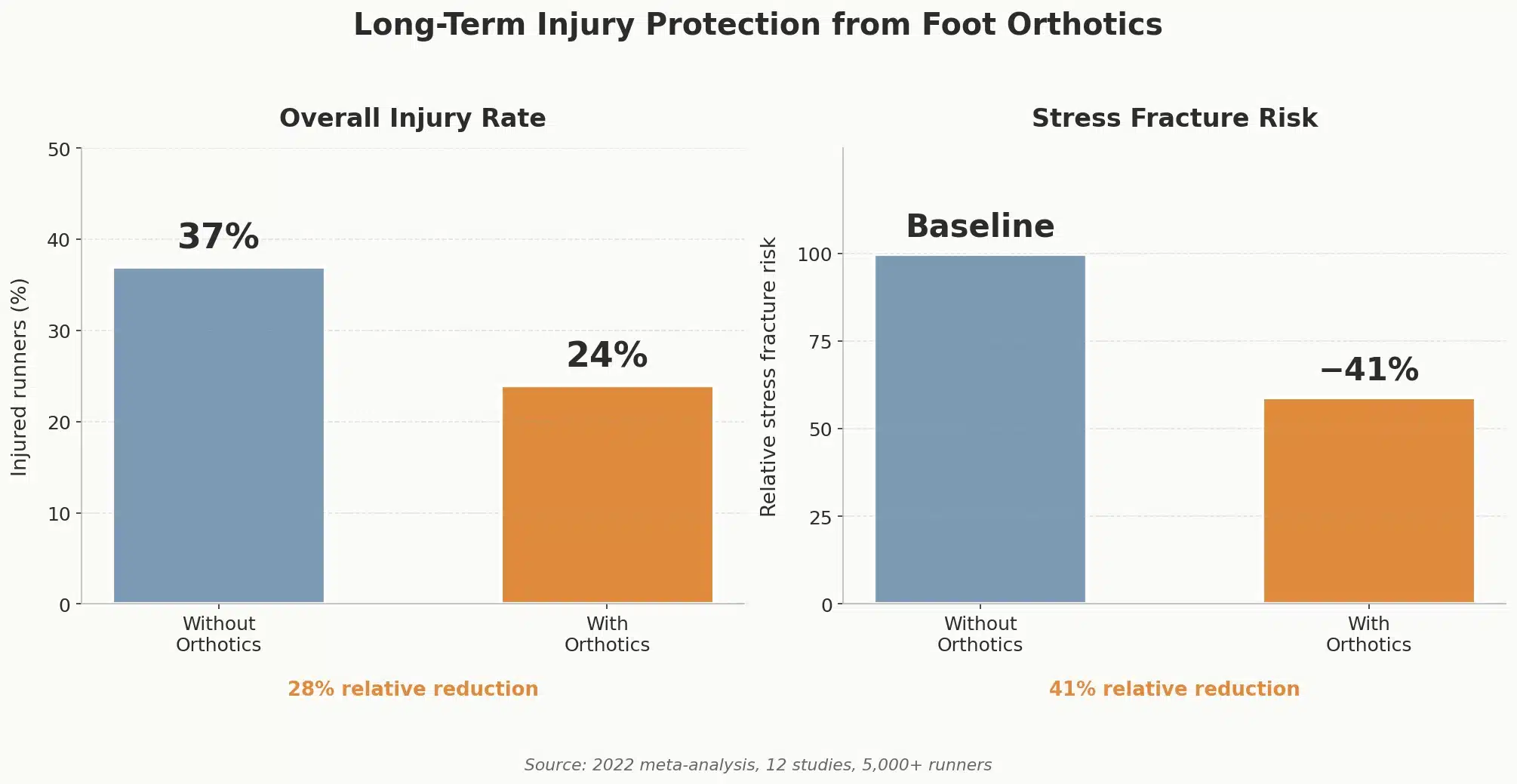
That’s significant safety, however there’s a catch: orthotics had a small damaging impact on operating economic system, which means your muscle groups work barely more durable and also you burn extra energy when operating in them.
Over years of operating, that effectivity tax provides up.
The choice to remain on orthotics long-term comes right down to a private trade-off: you get safety from sure accidents (notably stress fractures and pronation-related points), however you pay a small effectivity price and settle for some degree of muscle adaptation.
In case your harm historical past consists of stress fractures or persistent plantar fasciitis, that safety is well worth the trade-off.
Should you’ve been injury-free for a number of years and are simply sporting them out of behavior, the case is weaker.
Ought to You Keep on Orthotics Perpetually, or Can You Construct Your Method Off Them?
That is the place the proof and your private objectives must align.
There’s no single proper reply, however there are three evidence-backed paths.
Path one is accepting orthotics as a long-term instrument, the identical means you may settle for {that a} explicit shoe mannequin works on your stride or that icing after lengthy runs is a part of your routine.
Loads of lifelong orthotic wearers run injury-free careers and really feel no disgrace about staying in assist.
In case your orthotics have eradicated persistent ache or stop recurrent accidents, staying on them is a sound alternative.
Path two is constructing your means off orthotics by way of focused foot strengthening, which takes dedication however rebuilds your foot’s pure capability.
Analysis reveals that intrinsic foot muscle coaching considerably improves foot perform and arch stability impartial of exterior assist.
This path takes 6-12 months of constant work, beginning with energy workouts whereas nonetheless sporting orthotics, then steadily transitioning to impartial sneakers as your toes regain capability.
The energy work comes first, the transition comes second.
Path three is a hybrid method: proceed sporting orthotics for high-mileage weeks or lengthy runs, then rotate in impartial sneakers for simple runs and energy exercises.
This offers your toes stimulus to adapt and keep robust with out the all-or-nothing transition danger.
Which path you select depends upon your harm historical past, your objectives, and your danger tolerance.
Orthotics aren’t a life sentence, and intrinsic foot muscle coaching can rebuild foot perform sufficient to allow a gradual 6-12 month transition to impartial sneakers.
Whichever path you select, the underlying precept is identical: your toes want stimulus to remain robust and resilient.
Should you’re on orthotics, add energy work to the combination and your muscle groups gained’t atrophy.
Should you’re transitioning off them, give your self 6-12 weeks and prioritize foot strengthening workouts.
Should you’re deciding whether or not to remain on them, weigh your harm historical past and operating objectives towards the small effectivity price.
Your toes are able to extra adaptation than you may assume, however that adaptation solely occurs in the event you demand it.
Lengthy-term orthotics use isn’t a lure, however it’s a alternative that requires lively administration.
Make the decision intentionally so that you keep on orthotics by alternative as an alternative of by inertia.
