

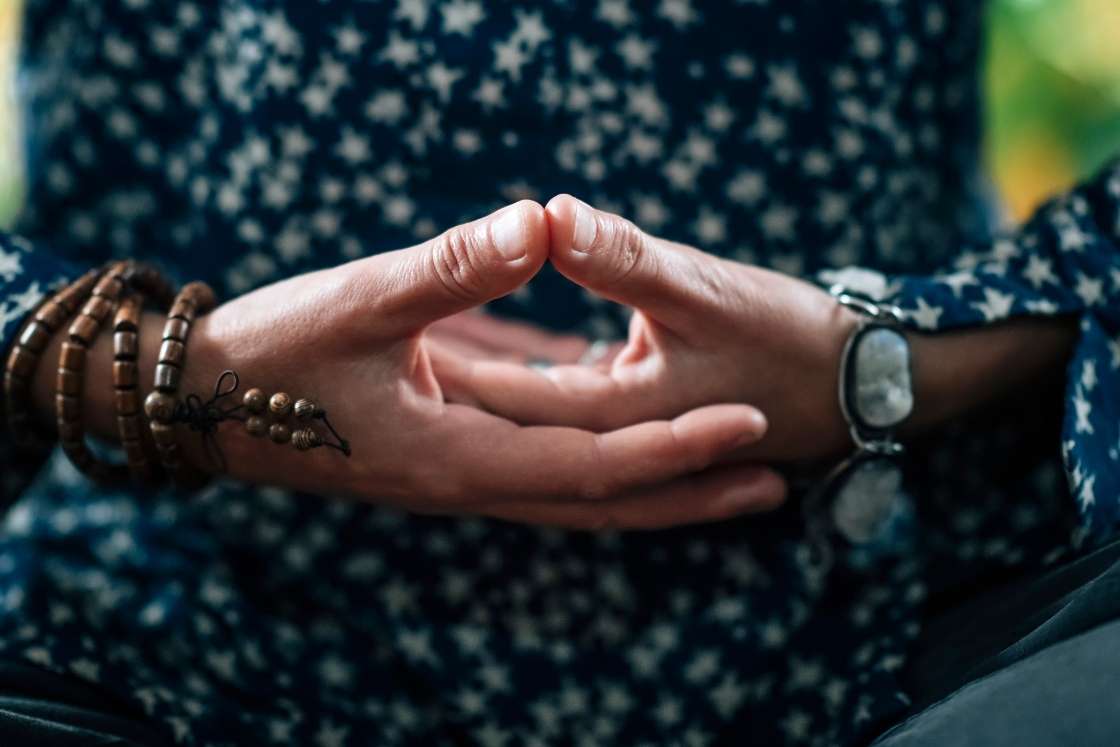
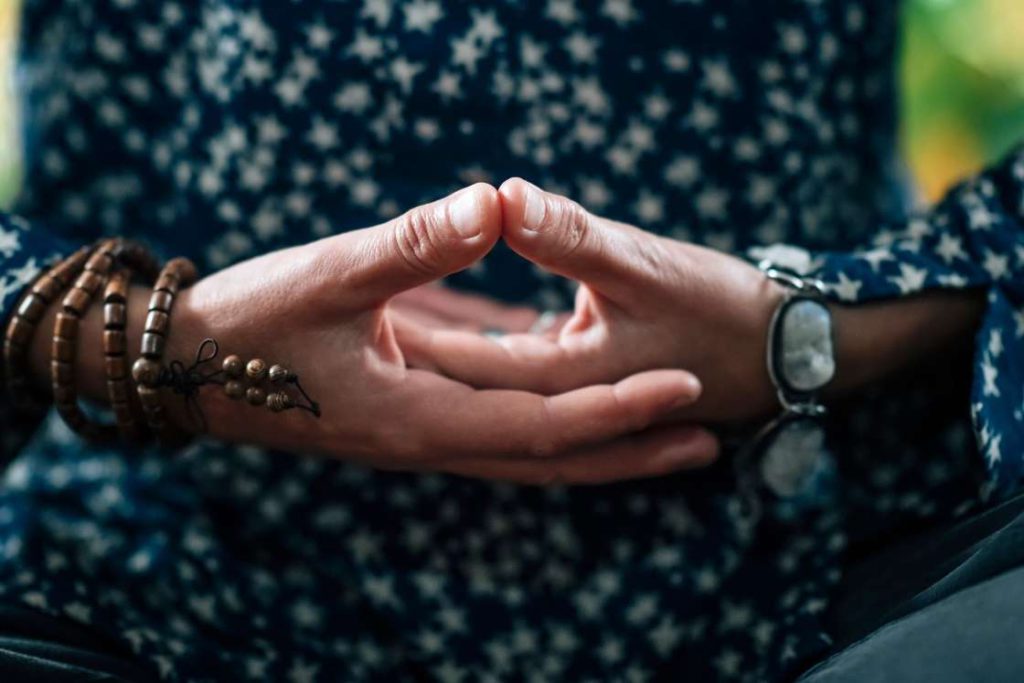
Dhyana Mudra is a straightforward hand gesture utilized in meditation to carry the thoughts into a relaxed and regular state. It’s generally practised in yoga to assist focus, consciousness, and internal stillness.
It’s carried out by putting the best hand over the left hand, with the guidelines of each thumbs gently touching to kind a refined triangular form.
This hand place helps enhance focus and balances the twin nature of the thoughts, as all 5 parts (Panch Tatva) are believed to return collectively on this gesture.
In yogic philosophy, Dhyana refers to a steady movement of consciousness with out distraction:
Tatra pratyaya-ikatānatā dhyānam
When there may be an uninterrupted movement of ideas and consciousness, the Dhyana (meditation) arises.
~ Yoga Sutra of Patanjali [Chapter 3. Verse 2]
That means
The phrase Dhyana comes from two Sanskrit roots: Dhi (thoughts or consciousness) and Yana (path or course of). Collectively, Dhyana means the apply of centered consciousness or meditation.
In yoga philosophy, Dhyana is likely one of the eight limbs described by Patanjali. It refers to a state the place the thoughts flows constantly in a single course with out distraction.
Dhyana Mudra represents this meditative state by means of the fingers. The mild becoming a member of of the thumbs creates a triangular form, symbolising stability, stability, and internal consciousness.
It’s usually in contrast with Gyan Mudra, which can be utilized in meditation. Whereas each assist focus, Dhyana Mudra is extra generally related to deeper stillness and sustained consciousness.
In Buddhist custom, this mudra is seen within the meditation posture of Gautama Buddha throughout his enlightenment underneath the Bodhi tree. Nevertheless, its roots return even earlier in yogic practices, the place it was used to deepen meditation and consciousness.
Symbolic Illustration
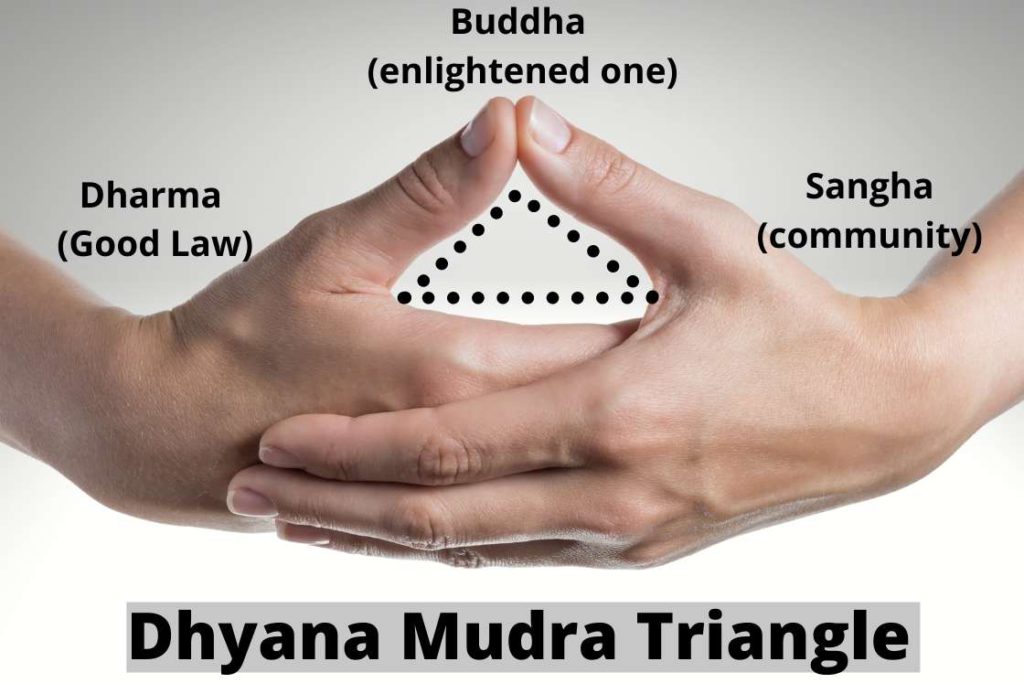
Within the Buddist side, the triangle shaped by becoming a member of thumb ideas in Dhyana Mudra represents the three jewels of Buddhism: Buddha, Sangha (group), and dharma (Good regulation).
Moreover, the best hand signifies information, knowledge, and consciousness and the left-hand represents the fantasy of existence on this world. When the best hand is positioned over the left hand in Dhyana Mudra, it represents the dominance of information and consciousness over the illusions created by the world.
It additionally signifies the stability of dualities (photo voltaic and lunar power, cold and warm, masculine and female energies) within the physique. The entire gesture signifies the stability of all the weather and soul.
Methods to Do Dhyana Mudra (Steps)
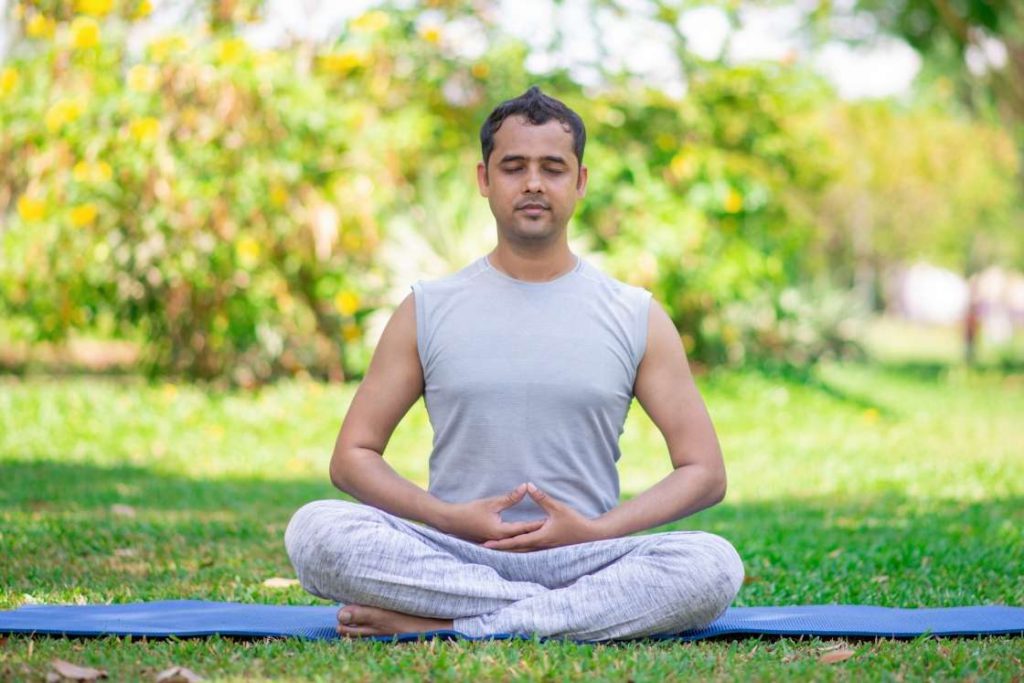
- Sit in a cushty yoga pose corresponding to Sukhasana or Padmasana. Ensure that to maintain your backbone straight.
- Relaxation your left hand on the lap, palm going through upwards.
- Now, place the again of your proper hand over the left-hand retaining fingers aligned to one another and stretched totally.
- Then, contact the tip of the thumbs of each fingers collectively. This may kind a triangle like construction along with your fingers and thumb.
- Now, gently shut your eyes and take deep and sluggish breaths.
- Maintain this hand place unmoved for no less than Quarter-hour. As soon as you’re finished, open your eyes slowly after which launch the mudra easily.
Variation
Dhyana mudra will be carried out with somewhat variation. On this variation, the sitting posture is similar as above, however the place of the hand is barely completely different.
- Curl the index finger to the touch the tip of the thumb. It is going to make a circle like Gyan Mudra’s fingers, do that with each fingers concurrently.
- Now, retaining the palms upwards, put left hand on the lap and right-hand palm over left hand’s palm (three fingers aligning to one another).
That is the alternate technique of finger association. The remainder of the method stays the identical as above.
Further Ideas
- Whereas holding fingers in Dhyan Mudra, one can Chant OM for higher focus. This may take consciousness to a deeper stage.
- It’s best to carry out this mudra together with the pranayama. This may improve the standard of meditation.
It’s all the time most popular to carry out this mudra within the morning time, with a recent thoughts. Nevertheless, When you face any issue performing it within the morning, you may carry out it at every other hour of the day.
Attempt to carry out Dhyana Mudra no less than 45 minutes a day. When you really feel it troublesome to do in a single sitting, you may carry out it 3 occasions a day (10-Quarter-hour every session).
Advantages of Dhyana Mudra
- Because the title suggests, Dhyana mudra is specifically designed to deepen the degrees of meditation. Consequently, it is rather useful within the non secular journey.
- Whereas practising this mudra, the left and proper components of the physique, in addition to the mind, are lively. In consequence, the apply of Dhyana Mudra brings stability between the left and proper areas of the mind, in addition to, the physique.
- This mudra brings calmness and leisure to the thoughts. Thus, it reduces damaging feelings corresponding to anger, anxiousness, despair, stress, and many others.
- Furthermore, this mudra stimulates the Ida and Pingla Nadis (astral channel) of the physique. This makes you attentive and centered.
- When one practices Dhyana Mudra often, it retains him/her away from all of the bodily and psychological sickness.
Conclusion
Dhyana Mudra reminds us that meditation doesn’t all the time want effort, however steadiness. This straightforward hand gesture helps internal stillness, stability, and consciousness.
Practised often, it may well gently information the thoughts towards readability and a extra peaceable state of being.
