

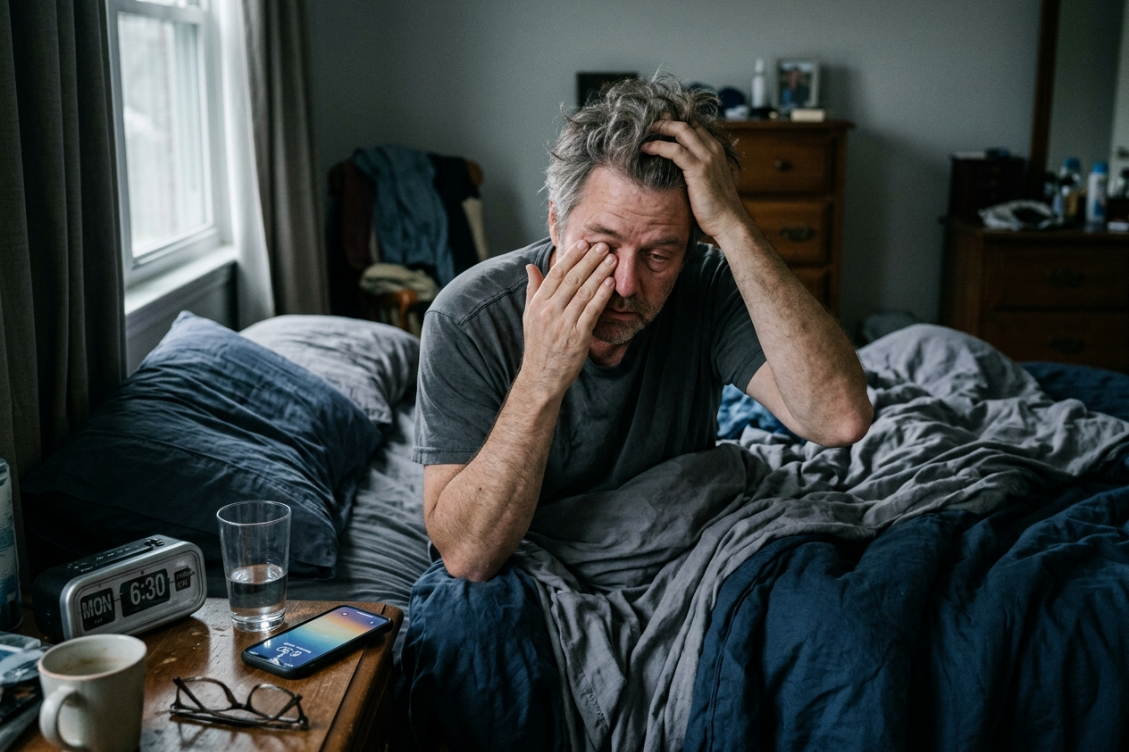
So what’s all of the fuss about altering the clocks and shedding one hour of sleep every year? It is annoying, positive. However what is the large deal? I imply, you are a weekend warrior. One hour is nothing in comparison with what you place your physique via on a typical Saturday evening. Besides you have seen one thing. A tough weekend, a late evening, a stretch of poor sleep, and your blood sugar numbers are off for a day or two afterward. You thought it was one thing you ate. It wasn’t random. Sleep and blood sugar management are extra tightly related than most of us need to admit.
What daylight saving time does, twice a yr, is run that experiment on the whole inhabitants without delay. And what it reveals is one thing you may have already been residing all year long with out totally naming it.
I do not love that connection any greater than you do. However details are details.
On this article, I need to discover what the daylight saving time experiment reveals about sleep loss, blood sugar management, and cardiovascular danger. Then we’ll take a look at some sensible steps that we each must take all yr lengthy, not simply in March.
The Analysis: Daylight Saving Time Is a Actual Well being Occasion
The spring clock change is not only an inconvenience. Research have tracked it as a set off for measurable well being occasions.
The American Academy of Sleep Drugs reviewed the gathered proof and issued a proper place assertion in 2020. The assertion, authored by Rishi and colleagues and printed within the Journal of Scientific Sleep Drugs, concluded that the spring transition carries important public well being and security dangers, together with elevated charges of hostile cardiovascular occasions, temper problems, and motorized vehicle crashes.
On the cardiovascular aspect, a evaluation printed in Frontiers in Drugs by Föh and colleagues on the College Hospital Schleswig-Holstein discovered that medical analysis has linked seasonal clock modifications to elevated charges of stroke, myocardial infarction, depressive episodes and even inflammatory bowel situations. That may be a notable cluster of dangers from a single hour of misplaced sleep.
A examine from Chudow and colleagues at Montefiore Medical Heart, Albert Einstein Faculty of Drugs, printed in Sleep Drugs, appeared particularly at atrial fibrillation admissions. They discovered a big spike in AF hospital admissions within the days after the spring clock change, particularly in ladies. Atrial fibrillation issues right here as a result of it dramatically raises stroke danger and is intently tied to autonomic nervous system dysregulation, which is similar pathway that disrupts blood sugar management.
A more moderen giant examine from Rymer and colleagues at Duke College, printed in JAMA Community Open in 2025 and overlaying over 168,000 sufferers throughout 1,124 hospitals, discovered no important enhance in acute myocardial infarction through the week of the spring or fall DST transition. That’s necessary to notice. The science right here will not be all pointing the identical course. The atrial fibrillation and stroke information stay extra constant than the guts assault information. However the organic disruption from the spring clock change is actual, even when the downstream impact on coronary heart assaults is smaller than early research instructed.
Why the Spring Transition Hits Your Blood Sugar
Right here is the factor about your physique’s clock. It doesn’t simply govern once you really feel drained. It governs when your pancreas releases insulin, how sensitively your muscle cells reply to glucose alerts, and the way your liver manages saved sugar in a single day.
Stenvers and colleagues at Amsterdam College Medical Facilities printed a landmark evaluation in Nature Critiques Endocrinology in 2019 titled “Circadian Clocks and Insulin Resistance.” They discovered that the circadian timing system coordinates glucose metabolism all through the day. A central clock within the mind regulates whole-body insulin sensitivity and meals consumption. Peripheral clocks in your muscle tissue, liver, intestine, and pancreas fine-tune native responses. When these clocks fall out of sync with one another, or together with your precise light-dark cycle, insulin resistance can comply with.
That’s precisely what occurs within the spring once you lose an hour. Your physique’s inner clock doesn’t soar ahead immediately. It takes days to recalibrate. Within the meantime, you’re consuming breakfast when your biology nonetheless isn’t fairly awake, and asking your pancreas to carry out on a schedule it wasn’t ready for.
Researchers have a reputation for this mismatch between your social schedule and your organic clock. They name it social jet lag. Anothaisintawee and colleagues at Mahidol College in Bangkok studied over 1,000 adults with prediabetes and printed their findings in Chronobiology Worldwide in 2017. They discovered {that a} later sleep timing, an indication of circadian misalignment, was independently related to increased hemoglobin A1c ranges, even after accounting for physique weight, sleep period, and sleep high quality.
In different phrases, when your physique clock is out of sync together with your schedule, your long-term blood sugar management suffers.
The spring clock change creates social jet lag on a population-wide scale. It factors out what could possibly be taking place to you on a regular basis in the event you’re not getting enough sleep and staying on a daily schedule. Chronobiology exhibits that your physique does certainly have a schedule, and insulin resistance will increase once you deviate from it.
One Evening of Poor Sleep Is Sufficient to Shift Your Insulin Sensitivity
You may suppose a single hour of misplaced sleep is simply too small to matter. The analysis says in any other case.
Donga and colleagues at Leiden College Medical Centre printed a examine in Diabetes Care in 2010 that checked out what occurs to insulin sensitivity in folks with kind 1 diabetes after only one evening of shortened sleep. Proscribing sleep to 4 hours decreased peripheral insulin sensitivity by about 21 % in comparison with a full evening’s sleep. One evening.
An earlier randomized managed trial by González-Ortiz and colleagues, printed in Diabetes, Vitamin and Metabolism in 2000, discovered that 24 hours of sleep deprivation considerably raised steady-state glucose concentrations in wholesome topics, indicating a transparent drop in insulin sensitivity.
Each of those research above have been rather more excessive than only a single hour of misplaced sleep. So in the event you lose only one hour, the chance of impression could be very excessive, however the magnitude of the impression will not be almost as nice as what’s seen in these research right here.
The extra sobering discovering, although, comes from long-term information. Yaggi and colleagues at Yale College Faculty of Drugs adopted a cohort of males from the Massachusetts Male Ageing Examine for as much as 17 years, monitoring sleep period towards the event of kind 2 diabetes. They printed their leads to Diabetes Care in 2006. Males who reported sleeping 5 hours or much less per evening have been almost twice as prone to develop diabetes over the follow-up interval in comparison with these sleeping seven hours. Not twice as possible after years of consuming poorly. Twice as possible from sleep alone. That’s what continual quick sleep does when it compounds evening after evening, week after week.
Sleep Is Not Non-obligatory. It Is A part of Your Therapy Plan.
Right here is the larger message hiding contained in the clock change story.
The spring DST transition is dramatic sufficient that researchers can measure it throughout total hospital programs. However the identical biology is at work each single week for hundreds of thousands of individuals. Each late Saturday evening adopted by an early Monday alarm is a smaller model of the identical disruption. Researchers even have a reputation for it: social jet lag. It’s the continual, low-grade mismatch between your biology and your schedule, and it quietly raises your A1c, month after month, with out you ever connecting it to the nights you stayed up too late.
You might have in all probability already seen this in your personal numbers. A tough evening of sleep, and the subsequent morning’s studying is increased than you anticipated. You thought it was one thing you ate. Or simply a kind of days. It was not random. It was your circadian rhythm telling you precisely what it wanted, and never getting it.
So the takeaway from this text is not only “be careful in March.” It’s this: sleep is a metabolic intervention. Defending it each evening, not simply when the clocks transfer, is likely one of the strongest issues you are able to do in your blood sugar, your coronary heart, and your long-term well being.
Here’s what that appears like in follow.
Deal with your sleep window like an appointment you can’t miss.
Seven to eight hours will not be a luxurious. For somebody managing blood sugar, it’s a scientific necessity. Choose a constant bedtime and wake time and maintain to it seven days every week, together with weekends. The weekend is when most individuals expertise social jet lag, staying up late on Friday and Saturday after which questioning why Monday morning is so exhausting. See our article on making Monday morning simpler.
Get morning gentle day by day.
Inside half-hour of waking up, get outdoors and expose your eyes to pure daylight. That is essentially the most highly effective sign your mind receives to anchor your circadian clock. It helps your physique know when to be alert, when to secrete insulin effectively, and when to wind down at evening. 5 to 10 minutes, even on a cloudy morning, makes an actual distinction.
Eat on a constant schedule.
Your pancreas, liver, and intestine every have their very own peripheral clocks which can be partly entrained by meal timing. Consuming at roughly the identical occasions every day, particularly a constant breakfast, helps hold your peripheral clocks synchronized together with your central mind clock. Skipping breakfast or pushing meals later throws off the timing of insulin secretion, even when your meals selections are good.
Anchor your mornings with vitamins, not simply caffeine.
What you eat very first thing issues greater than most individuals understand. A high-fiber, low-glycemic begin to the day offers your physique a gentle glucose curve to work with whereas your circadian system calibrates within the morning. Many individuals get by with out consuming breakfast till mid-morning. And if that is your regular schedule, then your physique will get used to it.
Different folks want one thing to eat sooner. For these folks, the high fiber, low-glycemic begin makes plenty of sense. We have now discovered that banana berry smoothies, made with ½ cup of almonds per blender (for 3 adults), and particularly with added flaxseed (1-2 Tbsp per individual), meet that standards very nicely. They don’t trigger a excessive blood spike in most individuals. B-Flax D is a really handy strategy to get flax fiber and fortified vitamins into your breakfast smoothie.
Transfer after meals, day by day.
A ten to 15-minute stroll after consuming helps your muscle tissue soak up glucose independently of insulin. It is likely one of the most reliably efficient instruments for flattening post-meal blood sugar spikes, and it really works no matter what time of yr it’s or how nicely your circadian rhythm is calibrated that exact week.
Across the spring clock change, give your self further margin.
Within the three to 4 days earlier than the spring transition, shift your bedtime 15 to twenty minutes earlier every evening. Watch your glucose readings extra intently for a number of days after the clocks transfer. Not with anxiousness, however with consideration. Your physique is working tougher throughout that window, and your monitor’s information will present it. Use it.
The clock change occurs twice a yr. Social jet lag occurs each week. Monday morning occurs each week. Your physique is protecting rating of all of it, on a regular basis. The query is whether or not you’re paying consideration.
A Hallelujah DIet Perspective
Exercise and relaxation are constructed into our every day and weekly schedules. God knew what He was doing when He created us, even telling us {that a} day of relaxation was not non-compulsory however needed. He put that rhythm into creation itself: gentle and darkish, seasonal shifts, work and relaxation. The Sabbath precept is not only a spiritual thought. It’s written into your very cells.
Whenever you stay in alignment together with your design, your physique features higher. So when the tradition tells you that sleep is for the weak and that fewer hours means extra productiveness, you aren’t simply making a life-style selection. You might be combating towards your personal biology. If you’re fastidiously managing blood sugar, you will note it in your numbers. Disrupt your schedule repeatedly, week after week, and your A1c will mirror it.
Sleep will not be a reward for a superb day. It’s a organic requirement for well being. Defend it, and you’re prone to discover that not solely is your bodily physique functioning higher, however your psychological readability improves, your choices get sharper, and a way of stability returns to your complete life.
That’s what it seems prefer to stay the way in which you have been designed to stay. And that’s value shouting about. Hallelujah!
References
1. Rishi MA et al. “Daylight saving time: an American Academy of Sleep Drugs place assertion.” J Clin Sleep Med. 2020;16(10):1781-1784.
2. Föh B et al. “Seasonal Clock Modifications Are Underappreciated Well being Dangers.” Entrance Med (Lausanne). 2019;6:103.
3. Chudow JJ et al. “Modifications in atrial fibrillation admissions following daylight saving time transitions.” Sleep Med. 2020;69:155-158.
4. Rymer JA et al. “Daylight Financial savings Time and Acute Myocardial Infarction.” JAMA Netw Open. 2025;8(9):e2530442.
5. Stenvers DJ et al. “Circadian clocks and insulin resistance.” Nat Rev Endocrinol. 2019;15(2):75-89.
6. Anothaisintawee T et al. “Later chronotype is related to increased hemoglobin A1c in prediabetes sufferers.” Chronobiol Int. 2017;34(3):393-402.
7. Donga E et al. “Partial sleep restriction decreases insulin sensitivity in kind 1 diabetes.” Diabetes Care. 2010;33(7):1573-7.
8. González-Ortiz M et al. “Impact of sleep deprivation on insulin sensitivity and cortisol focus in wholesome topics.” Diabetes Nutr Metab. 2000;13(2):80-3.
9. Yaggi HK, Araujo AB, McKinlay JB. “Sleep period as a danger issue for the event of kind 2 diabetes.” Diabetes Care. 2006;29(3):657-61.
