

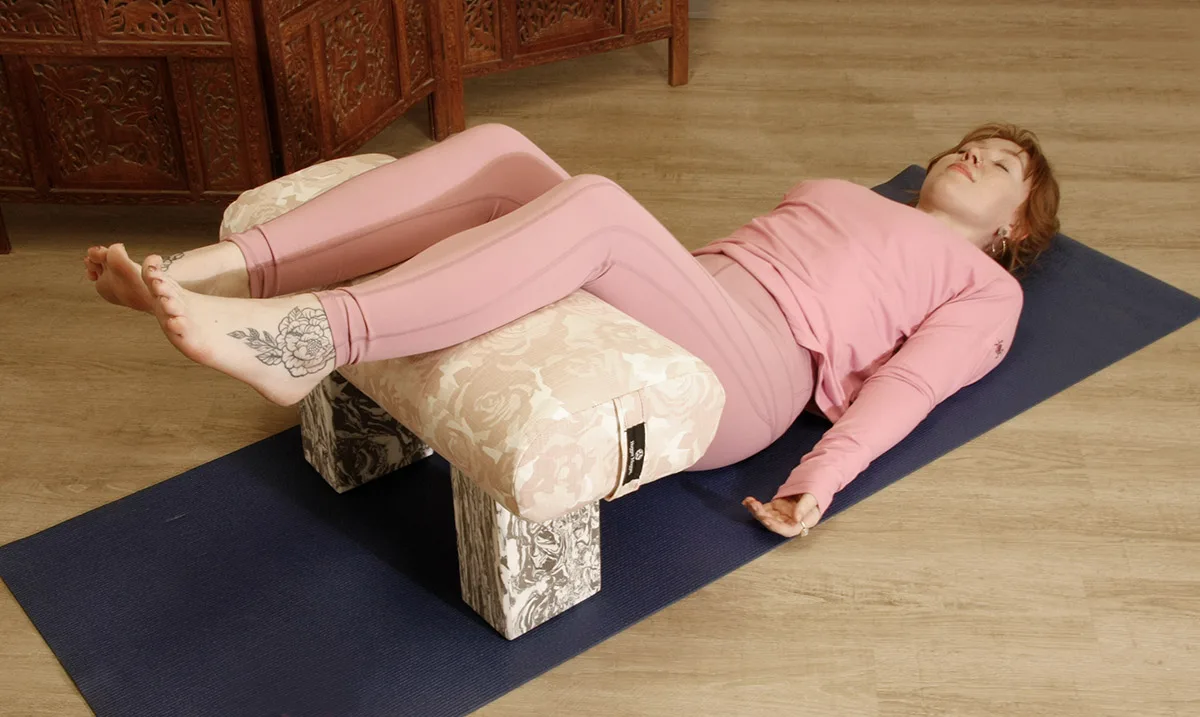
This entry was posted on Feb 25, 2026 by Charlotte Bell.
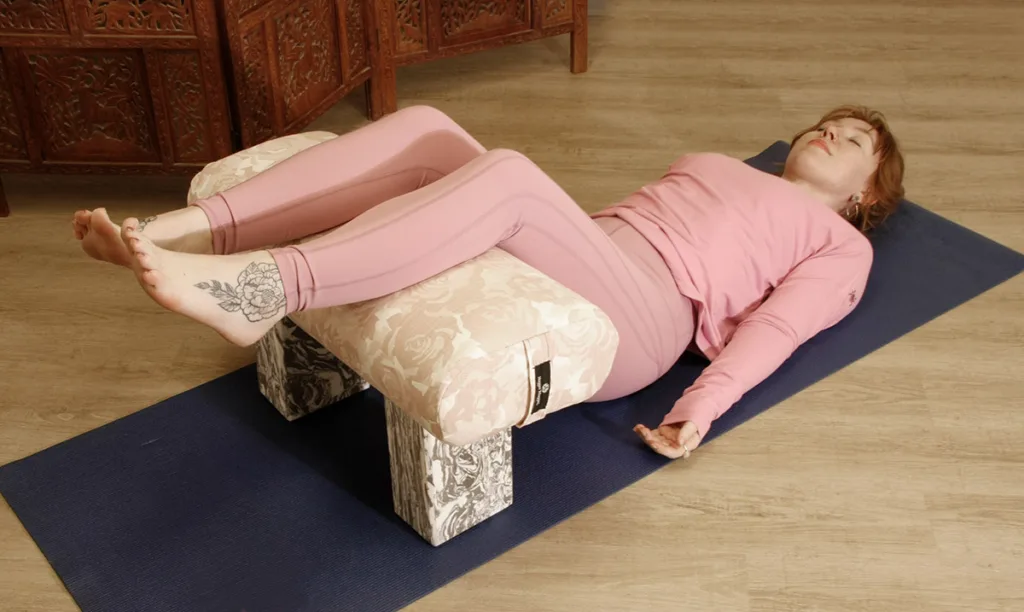
From the surface, Restorative Yoga and Yin Yoga look fairly comparable. Each contain passive poses, on the ground. Each kinds contain liberal use of yoga props—Yoga Blocks, Yoga Bolsters, Yoga Blankets and Yoga Straps. However regardless of the seeming similarities, each the intentions behind them, and the felt experiences of the 2 practices, are very totally different. When you‘d wish to make an knowledgeable selection between Restorative Yoga and Yin Yoga, which one is greatest for you in a given state of affairs?
The reply, as with so many questions on yoga follow is: it relies upon.
Restorative Yoga and Yin Yoga: The Similarities
When you’re searching for a slower, quieter yoga follow to decompress from a busy life, each Restorative Yoga and Yin Yoga can present a nonetheless counterpoint. In each yoga kinds, we maintain poses for an extended time, from a minute to 5 minutes or extra. (In Restorative Yoga, we will comfortably maintain poses for so long as 20 minutes!) Each kinds use the assist of yoga props to assist you to keep longer within the pose, and to control the feeling you’re feeling. Restorative Yoga and Yin Yoga each purpose to calm the thoughts and physique, and emphasize a mild strategy.
How Do Restorative Yoga and Yin Yoga Differ?
There are lots of variations between the 2 kinds. The primary is the intention behind every follow. In Restorative Yoga, the aim is to down-regulate your nervous system, and to shift you right into a parasympathetic (rest-and-digest) state. Yin Yoga’s intention is to entry deep connective tissue, similar to fascia, ligaments and tendons. Restorative yoga goals to create a way of opening, with little to no stretching sensation. Whereas Yin Yoga emphasizes a gradual launch into every pose, practitioners are join mentally and emotionally with evolving stretching sensations.
Restorative Yoga: Advantages and Contraindications
Restorative Yoga is usually thought of to be secure for anybody, even for folks with accidents. Listed here are among the advantages:
- Calms the physique and thoughts.
- Soothes nervousness.
- Shifts the autonomic nervous system from fight-or-flight to rest-and-digest.
- Releases muscular pressure.
- Boosts the immune system.
- Helps higher sleep.
- Promotes deep relaxation.
There actually aren’t any contraindications for training Restorative Yoga. The one one I can consider is that this: Folks experiencing despair may wish to give attention to the supine poses reasonably than the supported forward-bending poses. Ahead bending tends to advertise inward focus, which can or might not be a good suggestion for folks experiencing despair.
Yin Yoga: Advantages and Contraindications
Listed here are among the advantages of Yin Yoga:
- Will increase circulation by enjoyable smooth tissue.
- Calms the thoughts and physique due to the slower tempo.
- Consideration to delicate physique sensation fosters focus.
- Releases pressure within the fascia.
- Improves joint mobility.
- Brings stability to the organs via meridian stimulation. The idea behind that is that the meridians reside within the fascial layer of the physique. In accordance with the follow, longer holds take us deeper than the muscular layer of the physique, into the connective tissues. This influences the meridian system.
Opinions abound about whether or not Yin Yoga is contraindicated in sure instances. Some proponents contend that the aim is to emphasize, and to not stretch, connective tissues. Others emphasize the stretching side. Opponents of Yin Yoga warning that practitioners who’re hypermobile, pregnant, or who’ve osteoporosis mustn’t follow Yin Yoga. When you’re fascinated by training Yin Yoga, it is likely to be good to discover these opposing opinions to find out whether or not the follow is best for you.
Listed here are typically, however not universally, accepted contraindications:
- These with latest or ongoing again, neck, sacroiliac (SI) joint or hip harm ought to keep away from or proceed with warning.
- Ligaments, notably these across the hip joints, are already extra versatile throughout being pregnant due to the hormone relaxin. Most of Yin Yoga’s poses emphasize lower-body stretching, so pregnant folks ought to follow with care.
- Hypermobile folks typically don’t want to extend joint mobility. As an individual born with a hypermobile physique, I benefit from the lengthy holds and quiet of Yin Yoga. However I follow for at least sensation. My physique doesn’t have to be extra versatile, so after I follow passive poses with longer holds, I keep properly inside my comfy vary of movement as an alternative of pushing my “edge.”
- Folks with osteoporosis ought to proceed with warning. Yin Yoga emphasizes plenty of seated forward-bending poses, which might exacerbate the kyphotic thoracic curve.
Once more, I encourage you to look additional into Yin Yoga. Right here’s a web site that goes extra deeply into cautions for Yin Yoga. This web site provides a distinct perspective.
Working towards Restorative Yoga and Yin Yoga
Each Restorative Yoga and Yin Yoga encourage practitioners to maneuver slowly and with care. Restorative Yoga poses are designed to advertise opening, with minimal sensation, reasonably than stretching. So it’s vital to set your self up with plenty of yoga props so that every one your joints are supported. Whereas there will likely be some stretching sensation in Yin Yoga, lecturers urge college students to maneuver slowly and to not push their edge. When you’re going to follow both type of yoga, it’s sensible to follow with an skilled trainer who can present you tips on how to prop your poses for max profit.
These two sorts of yoga follow don’t should be mutually unique. You may follow Yin Yoga if you really feel that your physique would love a soothing stretch. And you may follow Restorative Yoga when your nervous system feels frazzled. Take note of the aftereffects of every follow, to be able to make knowledgeable decisions about which type to follow at what time. In both case, you should definitely give your self a pleasant, lengthy Savasana (Leisure Pose).
About Charlotte Bell
Charlotte Bell found yoga in 1982 and started instructing in 1986. Charlotte is the writer of Aware Yoga, Aware Life: A Information for On a regular basis Apply and Yoga for Meditators, each printed by Rodmell Press. Her third e-book is titled Hip-Wholesome Asana: The Yoga Practitioner’s Information to Defending the Hips and Avoiding SI Joint Ache (Shambhala Publications). She writes a month-to-month column for CATALYST Journal and serves as editor for Yoga U On-line. Charlotte is a founding board member for GreenTREE Yoga, a non-profit that brings yoga to underserved populations. A lifelong musician, Charlotte performs oboe and English horn within the Salt Lake Symphony and people sextet Pink Rock Rondo, whose DVD received two Emmy awards.
