

Watch a 2-year-old tear throughout a lounge, then watch a 10-year-old dash round a playground. The older little one is much sooner, but the toddler’s little legs appear to maneuver simply as shortly.
That distinction is the entire story of how working velocity develops. A toddler’s leg turnover is near maxed out nearly from the primary steps, so practically all of the velocity a child positive factors by childhood comes from some place else.
Researchers have measured precisely how working mechanics change from age 2 to maturity, and the findings reply the questions dad and mom truly seek for: how briskly can a baby run, when can a toddler actually run, and what a traditional stride seems to be like at age 10.
Right here’s what you’ll study:
- Roughly how briskly youngsters can run at every age
- When a toddler stops strolling quick and begins actually working
- Why little youngsters have such fast leg turnover
- What truly limits a baby’s prime velocity
How Quick Can Youngsters Run at Every Age?
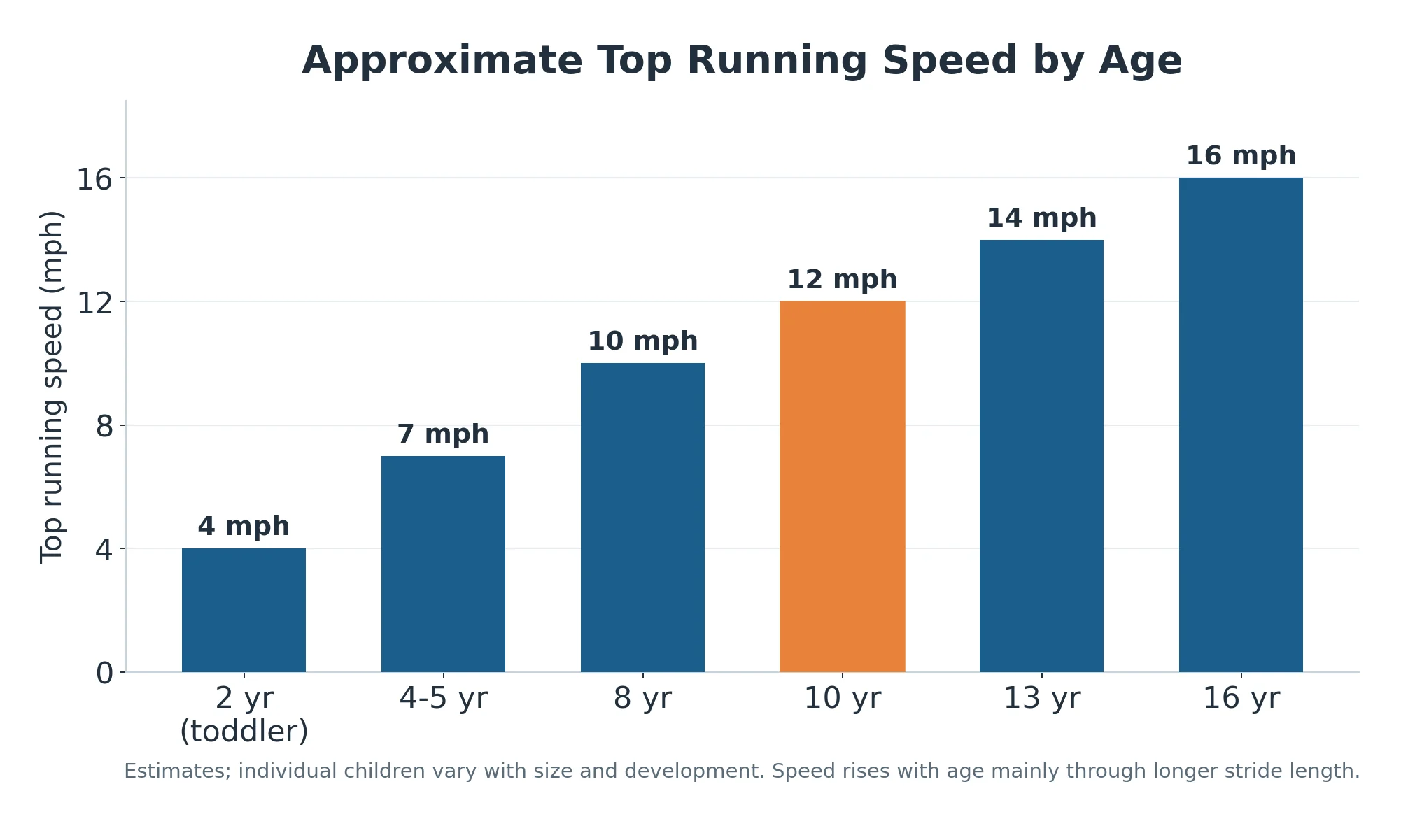
A toddler’s prime working velocity climbs steadily from the toddler years into the mid-teens, roughly quadrupling alongside the best way.
The numbers beneath are approximate. Particular person youngsters differ broadly with measurement, coordination, and the way a lot they run, so deal with these as typical ranges relatively than fastened benchmarks.
| Age | Approximate prime working velocity |
|---|---|
| 2 years (toddler) | 4 mph (6 km/h) |
| 4 to five years | 7 mph (11 km/h) |
| 8 years | 10 mph (16 km/h) |
| 10 years | 12 mph (19 km/h) |
| 13 years | 14 mph (23 km/h) |
| 16 years | 16 mph (26 km/h) |
The sample issues greater than any single determine. Pace rises with age in a easy, predictable approach, and it tracks progress way more intently than it tracks follow or teaching.
The explanation comes down to 2 components of working that develop on totally different clocks. Leg turnover, the one factor youngsters already do nicely, barely impacts prime velocity, whereas stride size units it and grows straight with the physique.
A toddler’s quickest working gear is proscribed nearly solely by how lengthy their legs are, not by how shortly they will transfer them.
Can a 2-Yr-Outdated Truly Run?
A 2-year-old can run, however solely in a tough, early model of the motion. True working requires a flight part, the second when each toes depart the bottom directly, and that part is barely current at age 2.
A 2021 evaluation of kids aged 2 to 9 discovered that the flight part grows with age however by no means exceeds 20% of the working stride, and that younger youngsters lean on a walk-run technique whereas they study.

What seems to be like working in a toddler is usually a quick stroll with transient airborne moments spliced in. The kid quickens, catches a bit air, then drops again right into a strolling sample when steadiness runs out.
That very same analysis discovered one thing helpful for fogeys: how mature a baby’s working seems to be doesn’t line up neatly with their actual age. Two youngsters born the identical month will be at very totally different levels.
So a 2-year-old who appears to run in every single place and one who nonetheless principally fast-walks are each growing usually. The airborne, adult-style stride fills in regularly over the subsequent a number of years.
Why Do Little Youngsters Have Such Quick Leg Turnover?
Toddlers transfer their legs at a cadence that might exhaust an grownup, and it comes right down to physics relatively than health. A working leg behaves like a spring, and a brief, mild spring bounces sooner than a protracted, heavy one.
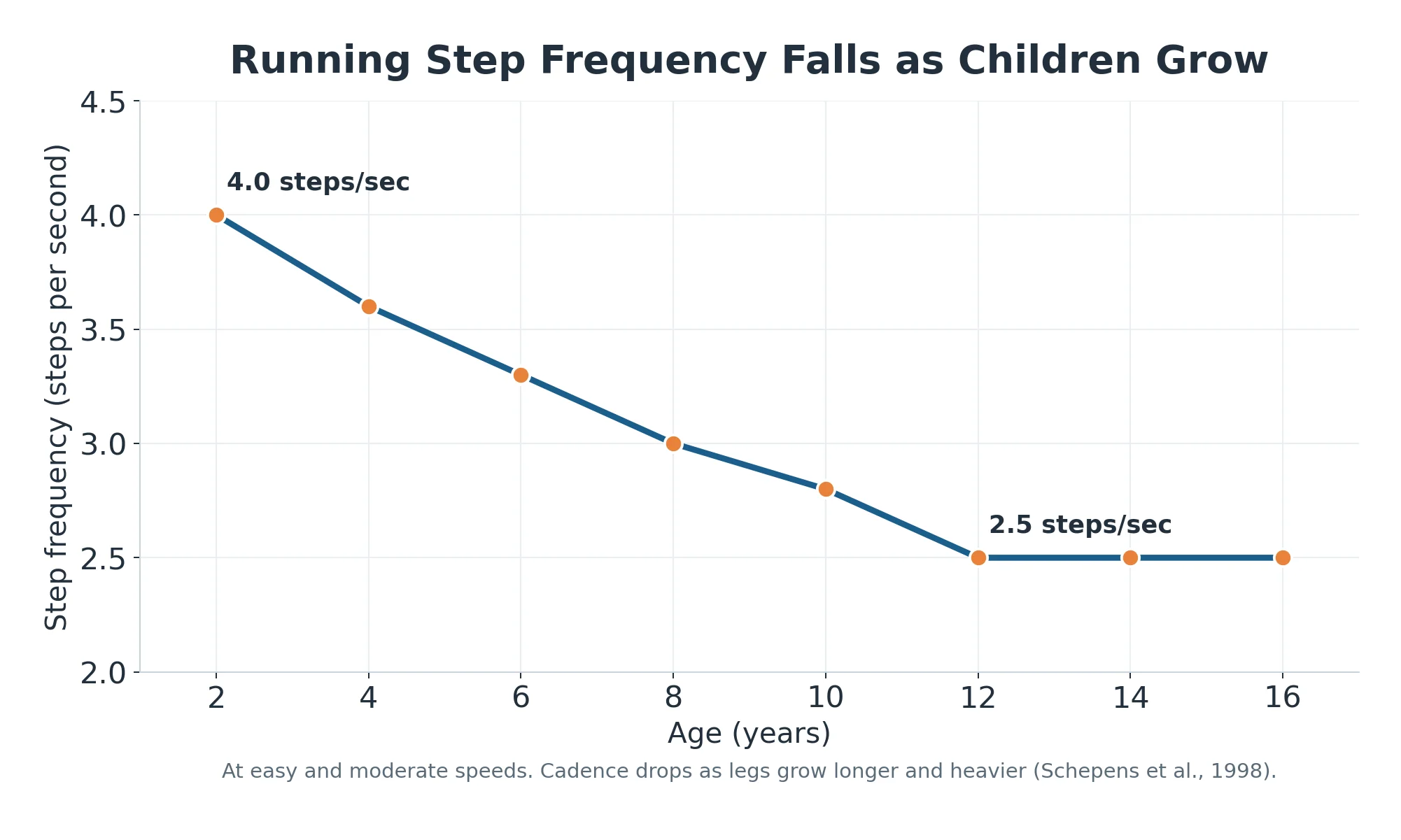
Basic analysis on working in youngsters measured step frequency falling from about 4 steps per second at age 2 to roughly 2.5 steps per second after age 12.
As a baby grows, the legs get longer and heavier, so the pure bounce of the working spring slows down. Step frequency drops with age although the kid is getting sooner general.
This spring-like bounce holds at straightforward and reasonable speeds, as much as about 8:45 per mile (5:27 per km). Beneath that tempo, a runner of any age lands and pushes off in a easy, symmetric rhythm set by the physique’s pure frequency.
Above that velocity the rhythm modifications, and the runner has to push off the bottom tougher and spend extra time floating. That threshold is ready by gravity, which is why it holds on the identical tempo regardless of the runner’s age or measurement.
That 4-steps-per-second cadence in a 2-year-old is about what an elite grownup sprinter reaches at full velocity. The toddler stays gradual anyway, as a result of every of these fast steps covers so little floor.
What Is a Regular Operating Stride for a 10-Yr-Outdated?
Stride size is what truly units a rising runner’s velocity, and at age 10 it sits roughly midway between a toddler’s and an grownup’s. A typical 10-year-old covers someplace close to 3 to 4 toes per working step at a tough effort, in contrast with 4 to five toes for a grown grownup.
These figures shift with the kid’s top and leg size, so a tall 10-year-old will naturally out-stride a shorter classmate on the identical turnover. Leg size is the strongest single predictor of how briskly a baby can dash earlier than puberty.
A 2026 research of younger athletes discovered that earlier than puberty, leg size drives most dash velocity by growing step size, whereas after puberty muscle power takes over.
Earlier than a baby hits their progress spurt, getting sooner is usually a matter of getting taller. Longer levers imply an extended stride on the identical fast turnover.
After the expansion spurt, the motive force modifications. Power and energy turn out to be the primary approach a younger runner provides velocity, as a result of turnover and leg size have largely settled.
How Do Runners Get Sooner As soon as They Cease Rising?
For teenagers previous their progress spurt and for each grownup runner, velocity now not comes from an extended leg. It comes from producing extra pressure into the bottom to elongate every stride.
Turnover hits a ceiling nearly instantly. A grown runner can’t meaningfully out-cadence a 2-year-old, so shifting your legs sooner stops paying off inside a couple of steps.
Your remaining velocity lever is stride size, and that comes from stronger, extra highly effective muscle tissue that drive you off the bottom. The hip extensors do most of that work, particularly the glutes and hamstrings that energy hip drive.
Power work like squats and lunges builds that pressure, and explosive drills like bounding, skipping, and brief uphill sprints educate the muscle tissue to use it quick. This is identical lesson the analysis on youngsters delivers: stride size, not turnover, decides your prime velocity.
You already flip your legs over about as quick as your physique ever will, so each bit of latest velocity has to come back from an extended, extra highly effective stride.
RunnersConnect Bonus
Obtain your FREE Hip Strengthening Workouts Information.
Obtain a video model of the 5 best hip workouts for runners. You’ll get full descriptions on the way to carry out and a video to assist information you.
What Can Grownup Runners Study From How Youngsters Run?
The best way youngsters develop velocity is a clear demonstration of what makes any runner quick. Watching turnover keep flat whereas stride size climbs strips the query right down to its necessities.
When you’ve got been making an attempt to run faster by elevating your cadence, the kid information explains why that plateaus. Cadence helps cut back affect, however it’s near fastened, so your added velocity has to come back from stride size as an alternative.
Level your coaching on the muscle tissue that reach your stride. Construct hip and glute power, add plyometrics, and run hills to transform that power into floor pressure.
That’s the shocking payoff of choosing aside how a toddler runs. The identical mechanics that cap a 2-year-old at a gradual jog are those setting your individual ceiling proper now.
