

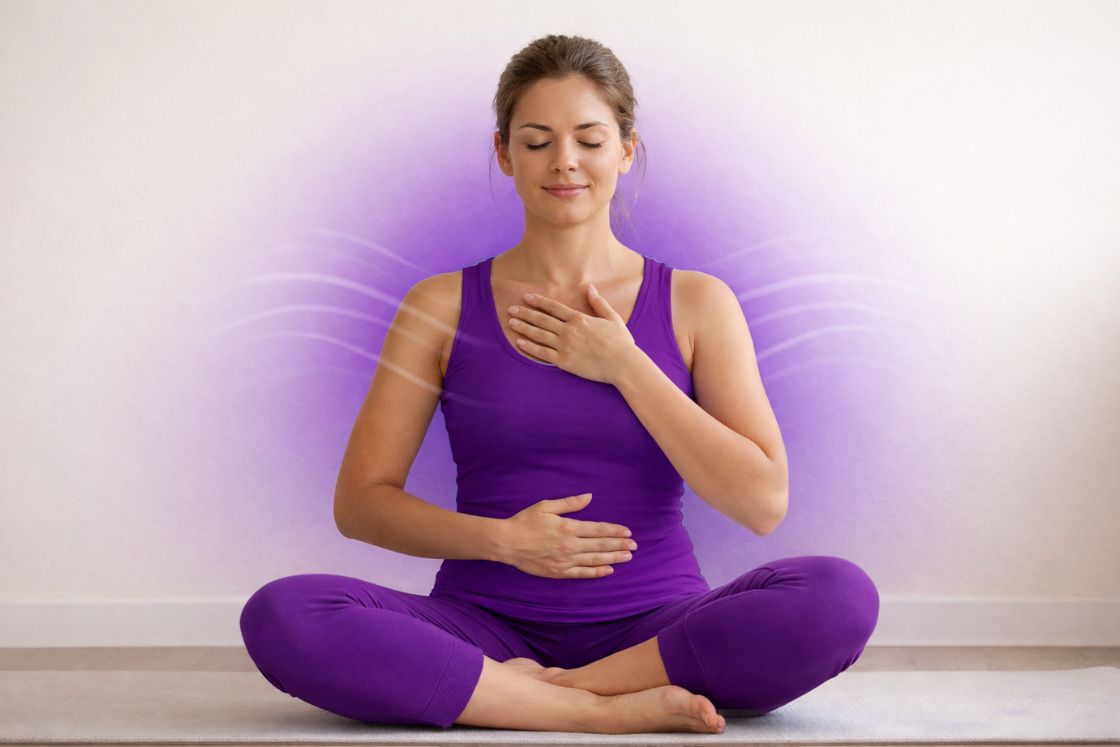
Most individuals begin yoga for the poses. Higher flexibility, a stronger physique, and fewer stress. That each one is sensible. However for those who ask an skilled trainer what actually issues in yoga, the reply is easy. It’s the breath.
Nonetheless, respiratory is commonly essentially the most ignored a part of observe. Many newcomers maintain their breath in poses, really feel out of sync with directions, or are not sure when to inhale and exhale.
So how must you breathe in yoga?
You need to breathe slowly and deeply via your nostril. Inhale when your physique opens, like lifting your arms or chest. Exhale when your physique folds, twists, or contracts. The breath ought to really feel regular, not compelled.
In yoga, respiratory is not only about air. It’s about consciousness, management, and the way your physique and thoughts work collectively. That is the place the thought of pranayama is available in, which is the standard observe of controlling the breath to information your vitality.
On this information, you’ll learn to breathe appropriately in yoga, when to inhale and exhale, and how one can construct a easy respiratory observe that truly improves your outcomes on the mat.
What Is Yoga Respiration, and What Is Pranayama?
Let’s clear this up, as a result of there’s actual confusion round it, particularly for newcomers.
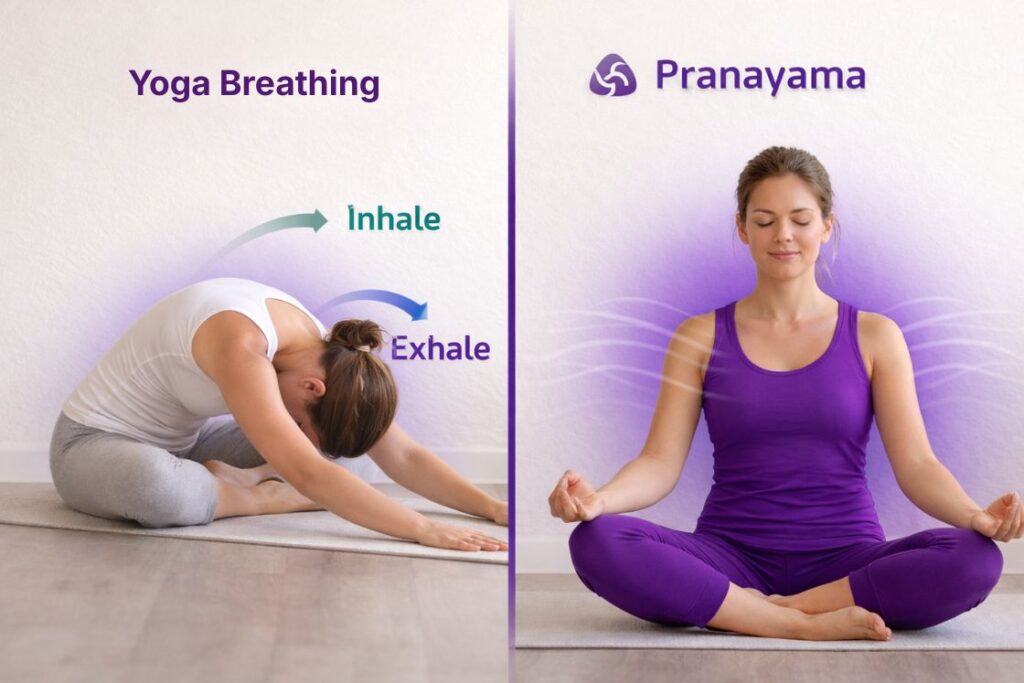
When most Western practitioners discuss yoga respiratory, they imply the aware manner of respiratory throughout a session. Inhale as you stretch or elevate, exhale as you fold or transfer inward, and maintain the breath gradual to remain calm and regular. It’s sensible, bodily, and efficient.
Pranayama goes deeper.
The phrase comes from Sanskrit. Prana means life drive or very important vitality, and ayama means enlargement or regulation. Pranayama is the observe of increasing and directing that vitality via the breath.
In conventional yoga philosophy, breath is not only air. It’s the medium via which prana strikes via the physique. Whenever you breathe with consciousness, you aren’t solely taking in oxygen. You’re influencing your nervous system, your psychological state, and your total degree of consciousness.
For this reason pranayama is described within the Yoga Sutras of Patanjali as one of many eight limbs of yoga. It was a proper observe lengthy earlier than fashionable yoga poses grew to become frequent. In some ways, the poses have been developed to organize the physique to take a seat comfortably and observe breath management.
So when respiratory is emphasised in a yoga class, it’s not only a approach. It comes from a a lot deeper custom.
For Western practitioners, this context issues.
If respiratory is seen as one thing secondary, it’s simple to overlook when observe turns into difficult. However once you perceive that the breath is central to yoga, not separate from it, the best way you method your observe begins to shift. The poses really feel completely different, the thoughts turns into steadier, and the observe begins to return collectively in a extra significant manner.
Fast Distinction
| Yoga Respiration | Pranayama |
|---|---|
| Used throughout poses | Practiced as a separate approach |
| Concentrate on motion and rhythm | Concentrate on vitality and consciousness |
| Easy and beginner-friendly | Extra structured and conventional |
| Helps coordination and circulation | Helps management thoughts and nervous system |
For most individuals, yoga respiratory is the start line. With time, it naturally leads into pranayama.
This distinction issues. When you deal with respiratory as only a background exercise, you’ll overlook it when observe will get arduous. However once you perceive that the breath is the core of yoga, your whole method adjustments. The poses change into simpler, the thoughts turns into calmer, and the observe feels extra full.
Be part of Our 5-Day Reside Pranayama Workshop
Why Respiration Accurately Modifications Your Total Yoga Observe
Earlier than we get into approach, it helps to grasp what’s really occurring in your physique once you breathe effectively, and once you don’t.
Your nervous system operates in two major states.
The sympathetic state is what most individuals know as struggle or flight. You are feeling alert, tense, and reactive. Your coronary heart charge goes up. Your muscle tissues are prepared for motion. That is helpful in genuinely hectic conditions, however many individuals keep on this state even when nothing is fallacious.
The parasympathetic state is the other. Relaxation and digest. Calm, open, and current. Your coronary heart charge slows down. Your muscle tissues calm down. Digestion works correctly. That is the place the physique recovers and really absorbs the advantages of your observe.
Right here’s the half that issues for yoga. You’ll be able to shift between these two states via your breath.
Sluggish, deep respiratory via the nostril tells your physique that it’s secure. Quick, shallow respiratory via the chest retains your physique in a stress response.
Your mind reads your respiratory sample as a sign about what is occurring round you.
You’ll be able to discover this throughout observe. Whenever you maintain your breath or breathe shallowly:
- your muscle tissues tighten
- your vary of movement reduces
- every part begins to really feel effortful
The observe feels tougher than it ought to. However when your breath is regular and deep, one thing adjustments.
Muscular tissues that have been gripping start to launch. You progress deeper into poses with out forcing. Your thoughts turns into quieter and extra targeted.
That calm, open feeling in a very good yoga class is not only from the poses. It largely comes from how you might be respiratory. For this reason the breath comes first.
Get the breath proper, and the remainder of the observe begins to open up. Ignore it, and also you miss a big a part of what yoga is definitely providing.
The Three-Half Breath: The place Each Yoga Scholar Ought to Begin
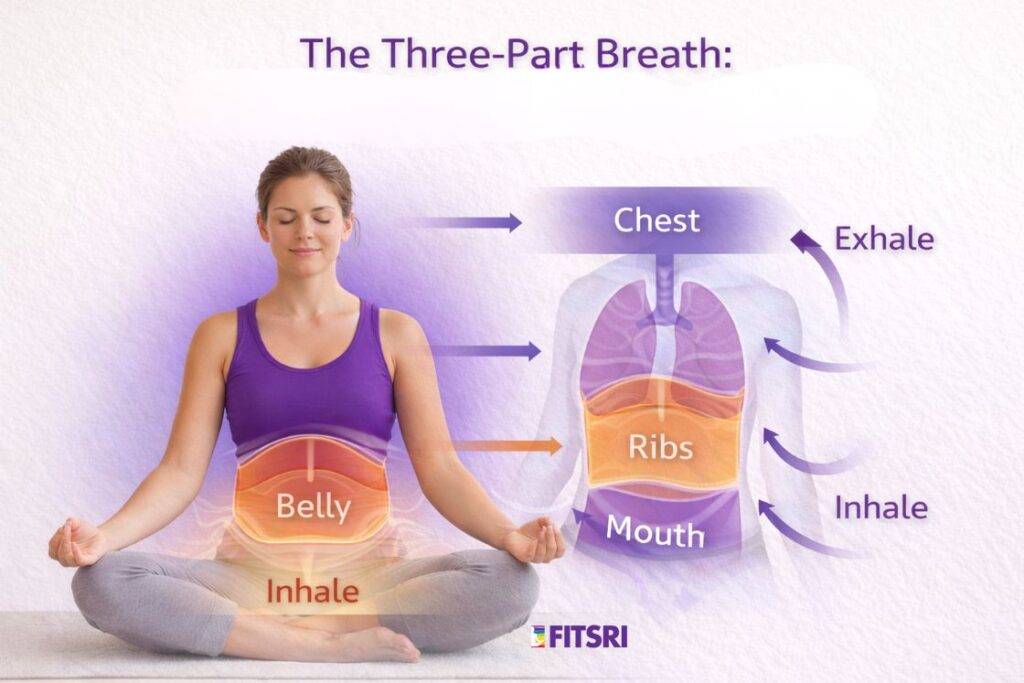
In yoga, this is called Dirgha Pranayama, or just the three-part breath. It’s one of the necessary respiratory practices to study. When you’re new to yoga, that is the place you must start.
The thought is simple.
A full breath doesn’t occur in only one place. It strikes via three areas of the physique:
- the stomach
- the ribcage
- the higher chest
Most individuals solely use one or two of those. The three-part breath helps you employ all of them collectively in a single easy, steady inhale.
Half 1: Stomach Respiration (Diaphragmatic Breath)
Begin by sitting comfortably or mendacity down. Place one hand in your stomach and the opposite in your chest.
Breathe in slowly via your nostril and let your stomach rise first. Your chest ought to keep principally nonetheless. As you breathe out, the stomach gently falls again in.
That is diaphragmatic respiratory.
The motion in your stomach is an indication that your diaphragm is working correctly and that you’re utilizing the decrease a part of your lungs. You aren’t really respiratory into the stomach, however the enlargement there reveals that the breath is deep and environment friendly.
That is how infants naturally breathe. Over time, many individuals shift to shallow chest respiratory attributable to stress or behavior.
Take just a few days to get snug with this half alone. Even a couple of minutes earlier than sleep could make a noticeable distinction.
Half 2: Ribcage Respiration (Thoracic Breath)
As soon as stomach respiratory feels pure, carry your arms to the edges of your ribcage.
As you inhale, really feel the ribs develop outward and sideways. As you exhale, they draw again in. The stomach stays comparatively regular right here.
This half brings consciousness to the center of the lungs.
It turns into particularly helpful throughout extra lively or demanding poses, when your physique wants extra breath. Studying to really feel this enlargement helps you regulate as a substitute of forcing your manner via a pose.
Half 3: Higher Chest Respiration (Clavicular Breath)
That is the ultimate and most refined half. After filling the stomach and ribcage, inhale a bit extra so the higher chest lifts barely. You could really feel a delicate rise across the collarbones and shoulders.
By itself, one of these respiratory is commonly linked to emphasize. However because the final a part of a full breath, it merely means the lungs are fully crammed.
Hold it mild. There isn’t any must exaggerate this half.
Combining It All: The Full Yogic Breath
Right here’s how one can put the three components collectively into one full breath:
Sit comfortably together with your backbone tall. Shut your eyes. Spend a couple of minute simply watching your breath as it’s with out altering something.
Then start. Inhale via your nostril in a gradual, steady wave: stomach first, then ribcage expands sideways, then higher chest and collarbones rise barely. Every thing fills in sequence with none jerking or stopping. Pause naturally on the high if it feels proper, with out straining.
Exhale within the reverse order: collarbones drop, chest releases, ribs contract inward, and eventually the stomach attracts gently in. Pause naturally on the backside, once more with out pressure.
Repeat this for five to 10 rounds earlier than any yoga session or meditation. It settles the nervous system, brings your consideration into the physique, and prepares you for every part that follows.
This, in essence, is pranayama in its most accessible kind.
When to Inhale and When to Exhale in Yoga Poses
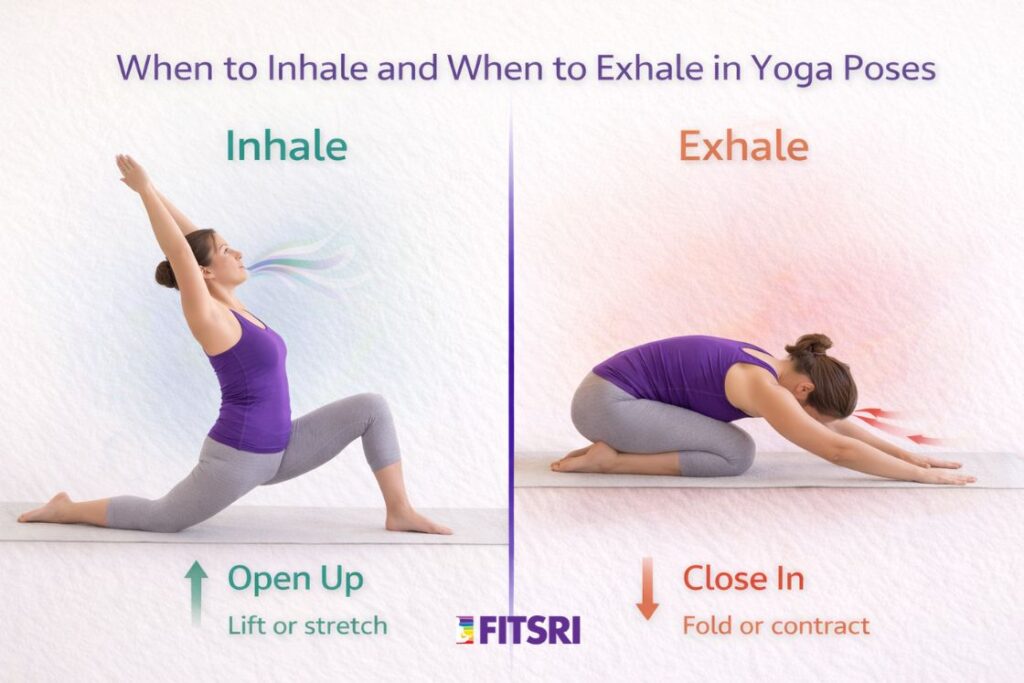
That is the place most newcomers get caught. You hear the trainer give a cue… and also you’re already half a breath behind. You find yourself guessing, making an attempt to catch up, and the entire class feels barely out of sync.
There’s a easy rule that works in most poses:
Inhale when the physique opens. Exhale when the physique closes.
That is grounded in easy anatomy. Whenever you inhale, your chest and stomach develop. Actions that open the entrance of the physique work naturally with this enlargement. Whenever you exhale, the chest and stomach compress and contract. Actions that fold or rotate the torso match this contraction.
Inhale into some of these actions:
- Backbends like Cobra, Camel, Upward-Dealing with Canine
- Lifting the arms overhead
- Opening the chest
- Lengthening the backbone
Exhale into some of these actions:
- Ahead folds like Standing Ahead Fold
- Youngster’s Pose Twists like Seated Spinal Twist
- Facet bends
- Reducing the arms or shifting inward
When you’re not sure, come again to this concept. Opening equals inhale. Closing equals exhale.
You’ll be able to really feel this for your self. Take a deep inhale and attempt to fold ahead. It feels restricted. There’s no house to maneuver. Now exhale absolutely and fold once more. You’ll go additional with out making an attempt.
The breath is just not following the motion.
The breath is creating the motion.
Breath Holds in Yoga (Kumbhaka)
In conventional pranayama, the pause between breaths known as kumbhaka. It’s a extra superior a part of the observe, nevertheless it helps to grasp the fundamentals.
There are two pure factors the place the breath might pause.
After an inhale, the physique feels expanded and alert. This could be a good second to remain nonetheless in a pose and really feel its full impact. Shifting from right here normally feels tougher as a result of the physique is already full.
After an exhale, the physique feels softer and extra relaxed. That is typically when you possibly can transfer barely deeper right into a fold or twist with out drive.
For newcomers, there’s no want to carry the breath on goal.
If a pause occurs naturally, let or not it’s.
If it doesn’t, that’s fully superb.
Forcing breath retention normally creates pressure, which is the other of what you need in yoga.
Be part of Our Reside 40-Day Kundalini Yoga Course
Nostril Inhaling Yoga: Why It Issues
In most yoga traditions, you might be requested to breathe out and in via the nostril.
This isn’t only a behavior or a rule. There’s a purpose for it.
Your nostril does extra than simply let air in.
It filters mud and particles, warms the air, and provides moisture earlier than it reaches your lungs. This protects the lungs and makes respiratory extra environment friendly. It additionally produces nitric oxide, which helps your physique use oxygen higher by enhancing blood circulation.
Nasal respiratory naturally slows the breath down.
Whenever you breathe via the nostril, the breath tends to be deeper and extra managed. Whenever you swap to mouth respiratory, it normally turns into sooner and shallower, staying within the higher chest. That form of respiratory retains the physique barely tense and reactive.
You’ll be able to really feel the distinction throughout observe. Nostril respiratory retains you regular and targeted.
Mouth respiratory typically reveals up when the physique is struggling or pushing too arduous.
From a conventional yoga standpoint, the nostril can be seen as the correct pathway for prana, or life vitality. The thought is that breath via the nostril helps each the physique and the thoughts in a extra balanced manner.
You don’t have to consider it in philosophical phrases to note the impact. In observe, nasal respiratory merely helps you keep extra current.
There are just a few exceptions.
Some practices like Sitali use the mouth to inhale for a cooling impact. In restorative yoga, a delicate sigh via the mouth could also be used to launch pressure. Generally newcomers briefly open the mouth whereas studying sure respiratory methods.
However most often, the nostril stays the default. In case your nostril is blocked attributable to a chilly or allergy symptoms, don’t drive it.
Breathe in no matter manner feels snug. The purpose is just not perfection. It’s consciousness and ease.
The Pranayama Strategies You’ll Encounter in Yoga
As soon as the three-part breath begins to really feel pure, you’ll come throughout particular respiratory methods in lessons or whereas studying about yoga. These are known as pranayama practices.
Every one has a special impact on the physique and thoughts. Some are calming, some are energising, and a few allow you to discover steadiness.
Listed below are the most typical ones you’re more likely to encounter.
Ujjayi Breath (Ocean Breath)
Ujjayi is the breath most frequently utilized in vinyasa and Ashtanga yoga.
You breathe out and in via the nostril whereas barely narrowing the again of the throat. This creates a mushy, regular sound, typically in comparison with ocean waves or the sound of fogging up a mirror.
If it feels complicated at first, do that. Exhale gently together with your mouth open and make a mushy “haa” sound. Then shut your mouth and maintain the identical feeling within the throat as you breathe via the nostril.
Ujjayi helps regulate your respiratory and offers your thoughts one thing to concentrate on throughout observe. It additionally builds a delicate inside warmth.
A easy solution to examine your self is that this. If the sound turns into strained or disappears fully, you’re probably pushing too arduous within the pose.
Nadi Shodhana (Alternate Nostril Respiration)
This is among the most calming respiratory practices in yoga.
You employ your fingers to softly shut one nostril at a time, alternating the breath between the left and proper aspect.
In conventional yoga, every nostril is linked to a special vitality. The left aspect is related to calm and cooling qualities, whereas the appropriate aspect is linked to vitality and exercise. This observe is claimed to steadiness each.
You don’t must focus an excessive amount of on the speculation to really feel the impact. After just a few rounds, the thoughts naturally turns into quieter and extra regular.
It’s particularly helpful earlier than meditation or earlier than sleep.
Kapalabhati (Cranium-Shining Breath)
Kapalabhati is extra lively and energising. It entails brief, forceful exhales via the nostril whereas the inhale occurs naturally in between. The stomach pumps inward with every exhale.
This observe is commonly described as cleaning and stimulating. It may possibly assist clear the thoughts and improve alertness.
Nevertheless, this isn’t one thing to leap into with out steering. It requires correct approach and consciousness.
It’s usually not advisable for folks with hypertension, coronary heart circumstances, nervousness points, or throughout being pregnant. When you’re not sure, it’s finest to study this with a trainer.
Bhramari (Buzzing Bee Breath)
Bhramari is easy however very efficient. You inhale via the nostril and exhale with a delicate buzzing sound, like a bee.
The vibration created by the sound has a chilled impact on the nervous system. Many individuals discover a direct sense of quiet and ease after only a few rounds.
It’s a useful observe once you really feel anxious, annoyed, or mentally overwhelmed.
Sitali Pranayama (Cooling Breath)
Sitali is used to chill the physique and calm the system. You inhale via the mouth, both by rolling the tongue right into a tube or by gently parting the lips if that’s not potential. Then you definitely exhale slowly via the nostril.
This creates a noticeable cooling sensation.
It’s particularly useful in scorching climate, after intense bodily observe, or once you really feel overheated, each bodily and emotionally.
5 Sensible Guidelines for Respiration Throughout Yoga
You don’t want to recollect every part without delay. These 5 ideas will assist you throughout completely different types of yoga and ranges of observe.
1. The breath leads, the physique follows.
Begin your inhale or exhale simply earlier than the motion begins. The breath initiates, and the physique responds. Even this small shift can change how transitions really feel.
2. When you’re holding your breath, discover it.
That is the most typical behavior on the mat, particularly when a pose turns into difficult. The second you discover it, take a aware breath. When you genuinely can not breathe in a pose, come out of it. The pose is just not extra necessary than the breath.
3. Match the size of your inhale and exhale.
A rely of 4 in and 4 out is an effective place to start. This sample, generally known as sama vritti, creates a gradual rhythm within the breath and helps settle the nervous system.
4. The breath is your suggestions system.
A easy, even breath normally means you might be working on the proper degree. When the breath turns into strained or uneven, you have got probably gone too far. That is typically a extra dependable sign than discomfort.
5. You’ll lose the breath. Come again.
This occurs to everybody. Your consideration shifts, a pose calls for extra effort, and the breath disappears. The observe is solely to note and return, with out overthinking it. Take a breath and start once more.
Respiration and the Nervous System: The Science Behind the Custom
Yogic lecturers understood the impact of breath on the thoughts lengthy earlier than fashionable science may clarify it. At present, analysis provides us the language for what the custom has all the time pointed to.
The vagus nerve is a key a part of the parasympathetic nervous system. It runs from the brainstem via the chest and stomach, linking the mind to main organs. Sluggish, regular respiratory stimulates this nerve and triggers a chilled response within the physique. Coronary heart charge slows, blood strain drops, cortisol ranges cut back, and the mind shifts towards a extra relaxed state.
In distinction, quick and shallow respiratory prompts the sympathetic nervous system. This retains the physique in a state of alertness. Over time, this sample can flip into ongoing stress, even when there is no such thing as a actual risk.
The steadiness between inhale and exhale additionally performs a job.
An extended exhale tends to extend parasympathetic exercise greater than an equal breath. For this reason exhale-focused respiratory feels calming and why many restorative practices place extra consideration on the exhale.
In conventional pranayama language, the inhale is linked with vitality and activation, typically described as photo voltaic or pingala. The exhale is related to launch and calm, described as lunar or ida.
Each are vital. Steadiness helps stability within the system.
However when the physique is beneath stress, putting extra consideration on the exhale can assist carry it again to a calmer state.
Frequent Yoga Respiration Errors (And Repair Them)
Figuring out what to keep away from is simply as helpful as realizing what to do.
- Respiration via the mouth by default: Many individuals, particularly these used to high-intensity exercises, swap to mouth respiratory as effort will increase. In yoga, the method is completely different. As an alternative of opening the mouth, deepen the breath via the nostril. When you can’t preserve nasal inhaling a pose, ease out of it barely.
- Holding the breath throughout transitions: This occurs typically when shifting between poses. The physique shifts, however the breath pauses. Set a easy intention to maintain respiratory via each transition, even when it’s only one regular breath.
- Respiration too quick: A fast, shallow breath is normally an indication of pressure or nervous vitality. Somewhat than making an attempt to regulate every part without delay, decelerate the exhale. An extended exhale naturally steadies the rhythm of the breath.
- Forcing the breath to match an excellent: It’s frequent to attempt to copy how a trainer sounds or breathes. This typically creates extra pressure than ease. Let your breath be pure. It’ll change into smoother over time with out forcing it.
- Ignoring the breath when issues get tough: That is an important one. When a pose turns into difficult, the breath is normally the very first thing to go. That second is just not an issue, it’s the purpose of the observe. Come again to the breath there.
Conclusion
In conventional yoga, there’s a saying that prana follows the thoughts, and the thoughts follows prana. The place your vitality goes, your consideration follows. The place your consideration goes, your breath goes. They’re carefully linked.
In easy phrases, once you study to information your breath, you start to information your thoughts. And when the thoughts turns into steadier, every part else turns into simpler to handle.
Within the West, yoga is commonly seen as a bodily observe with some rest advantages. That’s partly true, nevertheless it leaves out one thing important. The poses have been by no means the ultimate purpose. They have been a solution to put together the physique for stillness, consciousness, and a clearer way of thinking. The breath has all the time been central to that course of.
You don’t must observe any perception system to expertise this. The physique responds to the way you breathe, no matter philosophy. However once you method it with consideration, you start to see why these practices have been handed down for therefore lengthy.
Begin easy. Work with the three-part breath. Add ujjayi when it feels pure. Discover practices like alternate nostril respiratory over time.
There’s no must rush.
Stick with the breath, and let the observe construct from there.
FAQs
You exhale when bending ahead. Ahead folds compress the entrance of the physique, and exhaling helps the physique soften into the motion. When you attempt to fold on an inhale, it normally feels restricted as a result of the lungs are expanded.
Normally, you must breathe via your nostril. Nasal respiratory helps gradual the breath, improves oxygen use, and retains the nervous system calm. Mouth respiratory is normally an indication that the depth is just too excessive or the breath is just not managed.
This normally occurs when the breath is shallow or not coordinated with motion. It may possibly additionally occur if you’re pushing too arduous in a pose. Slowing down the breath, particularly the exhale, and easing out of the pose barely can assist you regain management.
Holding your breath creates pressure within the physique and retains the nervous system in a pressured state. It reduces stability and makes poses really feel tougher. When you discover you’re holding your breath, it’s an indication to pause, reset, and breathe once more.
Begin with easy respiratory consciousness. Concentrate on gradual, regular respiratory via the nostril and observe the three-part breath. As soon as that feels pure, you possibly can step by step discover primary methods like ujjayi or alternate nostril respiratory.
Even 3 to five minutes of aware respiratory earlier than a session could make a noticeable distinction. It helps settle the thoughts, regulate the nervous system, and prepares the physique for motion.
