

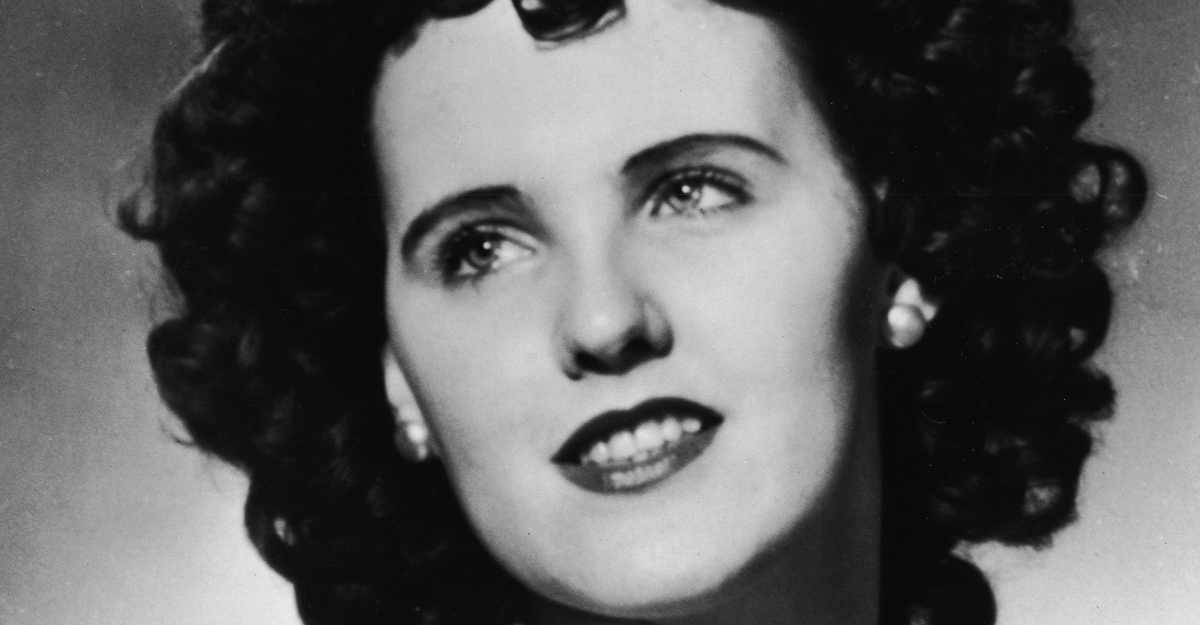
Elizabeth Quick appreciated to wander. Typically this wandering was merely in her thoughts, watching films and dreaming of a life far past her hometown of Medford, Massachusetts. Many instances, it was bodily; she’d land in a brand new metropolis—Miami, Jacksonville, Chicago, Lengthy Seaside, San Diego, Los Angeles—and discover its streets on foot. Typically her travels revolved round household, as when she tracked down her long-lost father and lived with him for a time—till he forged her out. On January 9, 1947, Quick, who was 22, informed a gentleman buddy to drop her off on the Biltmore Lodge in downtown Los Angeles, the place her sister was supposedly ready. She was by no means seen alive once more.
A recent model of Elizabeth—dreamy, elusive, unbiased, and canny—is likely to be referred to as a flaneuse, somebody curious in regards to the world. However we’ll by no means know what sort of life she would have led; by the point her bisected physique was present in a vacant lot, six days after she left the Biltmore, Elizabeth had ceased to be an individual. From then on, she grew to become “The Black Dahlia,” an archetype, a fable, a riddle that numerous folks have tried to unravel in books, movies, tv exhibits, podcasts, web sites, internet-message boards, and social-media posts.
“After we’re lifeless, the pretense that we could also be protected in opposition to the world’s careless malice is deserted,” Janet Malcolm wrote in her ebook The Silent Girl. She was referring to the poet and novelist Sylvia Plath, one other lovely younger girl who died too quickly, after which her life and phrases grew to become grist for the biographical mill. However Malcolm’s phrases apply equally, even eerily, to the afterlife of Quick—one in every of America’s most well-known homicide victims, and definitely among the many most persistent topics of the true-crime industrial complicated.
By William J Mann
From the second Quick’s killing grew to become headline information, sensation was the prime directive. With each new lead, confession, and suspect, the precise Elizabeth receded additional. It didn’t assist that she was an enigmatic character in life, liable to embellishment and even lies. She recounted tales of woe to paramours solely to ask them for cash, exaggerated her prospects in missives to her mom, informed pals a few lifeless husband and a toddler who in all probability didn’t exist—all with out letting on about her precise precarious straits. Quick prevented the highlight, however over the almost 80 years since her loss of life, it has wholly consumed her.
This type of flattening occurs all too typically with homicide victims, notably younger girls and ladies who die by the hands of a serial killer, normally male. (By no means thoughts that extra marginalized girls, particularly girls of coloration, are much less more likely to advantage any consideration in any respect.) In Quick’s case, the flattening is especially egregious, as a result of the inchoate info of her life are shoehorned into the obsessions of newbie sleuths who proceed to get these info unsuitable.
William J. Mann’s new ebook, Black Dahlia: Homicide, Monsters, and Insanity in Midcentury Hollywood, makes an attempt a special strategy: to weave the fragments we’ve right into a narrative complete that prioritizes Quick, in all of her contradictions, and tries to debunk many years’ value of gathered myths. Though Mann’s effort stands aside from the overlong run of books in regards to the case, it, too, is undercut by the necessity to identify a probable suspect, taking part in into the true-crime crucial it goals to depart behind.
Mann begins Black Dahlia in late July 1946, a number of months earlier than Quick’s homicide and never lengthy after her arrival in Lengthy Seaside, California. Over the following interval, Quick befriends girls and dates males; wears subtle clothes, ankle-strapped excessive heels, and flowers in her hair; and comes throughout as “a really modest lady who by no means cursed or acted horny,” within the phrases of 1 buddy. The reader comes to grasp why fascination has proved extra interesting than info: We all know little or no about her life. Quick defied norms and customs. She appeared harmless within the methods of males however savvy sufficient to maintain her dates at a respectful distance. The 2 girls who knew her greatest throughout this time, Marjorie Graham and Anne Toth, whom Mann renders extra totally than any creator earlier than him, nonetheless had bother understanding what made Quick tick.
Mann begins the story, nevertheless, from the vantage level of Tod Faulkner, who says he first noticed Quick in a two-piece bathing swimsuit, strolling alone towards the seashore, and noticed her once more a number of extra instances that summer time. Faulkner was 11 on the time, and says he by no means forgot her. But after rising as much as develop into a journalist, he was the one who immortalized the inaccurate center identify “Ann,” in a 1971 article for the Los Angeles Instances. Faulkner’s error would propagate in quite a few articles, books, and movies earlier than being codified within the 1975 TV film Who Is the Black Dahlia?, which starred Lucie Arnaz (the daughter of Lucille Ball and Desi Arnaz) as Quick. Already we’ve the battle between reality and fable, and we’re solely on web page 4.
From there, Mann situates the identified info about the previous few months of Quick’s life in postwar Los Angeles, whose rising homicide price led to a good sharper spike in concern. From 1945 to 1946, “whereas the murder price for males grew by 26.8 p.c, the variety of girls murdered in that very same interval shot up by 52.9 p.c,” Mann factors out. Over the following few years, the rise in violent deaths of ladies, seemingly by the hands of strangers, was mirrored within the rising style of movie noir and in novels together with Dorothy B. Hughes’s In a Lonely Place, which was revealed lower than a 12 months after Quick’s homicide.
Worry additionally offered newspapers, as any tabloid journalist on the time might let you know. And inform folks they did, notably within the early days and weeks after Quick’s loss of life, when the tiniest new element in regards to the “Black Dahlia” investigation—even, or particularly, if that element wasn’t true—might increase circulation. Mann calls out many cases of “sexing up the information” (a phrase he makes use of a number of instances): the outline of the block the place Quick’s physique was found as a “lover’s lane”; invented testimony from witnesses and members of the family (together with Quick’s grieving mom, Phoebe); exaggerations within the memoirs of the L.A. newspaper editors Agness Underwood and Jimmy Richardson, early chroniclers—and shapers—of the homicide narrative.
The errors and suppositions would multiply over the many years—most of them cataloged by the previous L.A. Instances reporter and historian Larry Harnisch. Was Quick a intercourse employee? Blame John Gregory Dunne’s in any other case terrific 1977 novel, True Confessions, which gave its Quick stand-in the moniker “The Virgin Tramp” together with a previous profession in pornography. (With out True Confessions, James Ellroy in all probability wouldn’t have written his personal The Black Dahlia novel in 1987, which led to a 2006 movie adaptation.) Did she have sexual dysfunction? That’s an invention of a former Examiner reporter, Will Fowler, bolstered by John Gilmore in his supposedly nonfiction 1994 account, Severed, which incorporates info from a detective, “Herman Willis,” who doesn’t appear to have existed.
False suspects additionally proliferated. Was George Hodel the killer? So his son Steve Hodel retains insisting, first in his 2003 ebook, Black Dahlia Avenger, then in a later ebook that additionally places George ahead because the Zodiac Killer (oy). Janice Knowlton, too, believed that her father murdered Elizabeth: Examine it in Daddy Was the Black Dahlia Killer. Piu Eatwell’s Black Dahlia, Purple Rose initially satisfied me that Leslie Dillon was the wrongdoer, however Mann’s account definitively guidelines Dillon out. Eli Frankel’s Sisters in Dying, revealed simply final 12 months, strains (and, to my thoughts, fails) to attach Quick to an unsolved homicide in Kansas Metropolis. And a brand new podcast hosted by Michael Connelly, Killer within the Code, additionally tries to attach the Black Dahlia and the Zodiac Killer, with the assistance of a “cold-case advisor” who bases his “smoking gun” on a deathbed sketch that higher resembles fan artwork.
Shiftiness, con artistry, and even violence towards girls don’t add as much as onerous, incriminating proof. Mann, too, succumbs to the temptation, maybe reluctantly; he spends treasured pages explaining why one in every of Elizabeth’s Lengthy Seaside boyfriends, a navy veteran named Marvin Margolis who died in 1993—the identical suspect in Connelly’s podcast—can’t be dominated out because the killer. (The unique detectives crossed him off the listing early within the investigation.) Even Mann appears dissatisfied when he mulls the prospect {that a} stranger killed Quick: “She was merely a susceptible younger girl who got here face-to-face with somebody with extreme and violent psychopathology who determined, both on impulse or deliberation, to kill her, to make use of her physique to precise rage and resentment on the world.”
After a lot time has handed, nobody is more likely to be happy with any identification of Quick’s killer. If the lead detective, Harry Hansen, is to be believed, the Los Angeles Police Division by no means as soon as interviewed the precise killer regardless of interrogating scores of suspects—together with all of these talked about in prior books, and now Mann’s. Any final result would seemingly resemble the identification final September, by way of investigative genetic family tree, of the person chargeable for the 1991 quadruple murder in Austin, Texas, often called the “Yogurt Store Murders.” In that case, pinning down the assassin didn’t erase the 34 years of anguish and harm sustained by the women’ households and the younger males wrongfully convicted—together with one who had been on loss of life row. After many years of ache and exploitation, fixing the case looks like an anticlimax.
“Fixing” the Black Dahlia case, most probably by means of genetic family tree, might deliver a solution, however it will solely generate many extra questions. Harnisch, the historian, who is aware of extra in regards to the case than virtually anyone (and has a reputable idea relegated to a footnote in Mann’s ebook), put it greatest in a 2020 interview: “This can be a story that fades to conjecture. This can be a story with out an ending.”
Look previous the necessity for narrative and there, out on the horizon, is Elizabeth Quick, strolling down a California boulevard, making an attempt to create a greater story for herself. She didn’t have to stay perpetually a woman wounded by her father’s rejection, too proud to confess the reality about her life to her mom and sisters, but resourceful sufficient to outlive, for a time, in a world that couldn’t care much less. Her luck ran out, and we don’t know why, or who killed her. However the brutality of Quick’s loss of life shouldn’t supersede her life any greater than fable ought to overshadow a bigger reality: that her homicide won’t ever really make any sense.
While you purchase a ebook utilizing a hyperlink on this web page, we obtain a fee. Thanks for supporting The Atlantic.
